Eight weeks until the baby arrives. The yarn is wound, the tea is made and the cardigan is cast on. Somewhere around the yoke the stitch count wanders off, and try as you might, you cannot work out how or why. You rip back, knit it again, and arrive at exactly the same wrong number. At this point most of you will blame yourselves, which is gracious of you but sadly often wrong. Here’s how to spot AI knitting patterns, and crochet ones too, before they eat away at your yarn, your evenings and your sanity.
I’ve been designing knitting and crochet patterns for 18 years. My first commission, a pair of socks, was in 2008, back when the most a computer could do for a knitter was print the pattern out. Every pattern I sell has been made with my own hands and sized against real children. I used to think that went without saying. Times are changing, though…
Quick Look
What you’ll find in this post:
- Why a pattern that won’t work might not be your fault
- How fake “free pattern” posts on Facebook really work
- Eight red flags that give away an AI knitting or crochet pattern
- A real crochet garment next to its AI copy, so you can see the difference
- How to check a designer was working before AI arrived
- A free printable checklist to keep by your yarn stash
It Wasn’t You: Why Knitters Blame Themselves
Here’s the part that worries me most. I’ve had countless conversations with knitters who have shared their experience of buying a pattern elsewhere, struggling to make it work, and deciding the problem must be them. They assumed their skills weren’t up to it, and some put their needles away altogether.
Only later did they discover they’d unknowingly bought an AI pattern. There was nothing wrong with their knitting. The pattern had never been knitted by anyone, because it couldn’t be.
This is the cruel trick at the heart of AI patterns. Newer knitters assume they’ve misread. Experienced knitters assume they’re tired, or that they’ve missed a line. Almost nobody’s first thought is “this pattern is impossible”, because for generations a pattern has meant one thing: somebody has already made it.
A real pattern is a record of something a real person has made, with the mistakes found and fixed along the way. An AI pattern is a guess at what instructions usually look like. It can be beautifully laid out, with lovely photos, and still not work at all.
If you’re teaching someone to knit, whether it’s a grandchild, a friend or the neighbour who keeps admiring your jumpers, this matters doubly. One bad pattern can be the end of a brand new hobby. If they get stuck, check the pattern before you check their stitches.
How to Spot AI Knitting Patterns on Facebook
If you use Facebook, you’ve almost certainly seen them. A page posts something extraordinary: a crocheted dragon blanket, a knitted cardigan smothered in roses, a baby asleep in a cocoon shaped like a strawberry. The caption says “Type YES for the free pattern!” and underneath, hundreds of people have dutifully typed YES.
Here’s what usually happens next:
- The link goes to a website stuffed with adverts, and the pattern is missing, a different pattern entirely, or a vague paragraph nobody could follow.
- The “free” pattern turns out to cost money, and the site asks for your card details. Some of these sites exist purely to collect them.
- The page wanted your YES, not your knitting. Every comment tells Facebook the post is popular, so it shows it to more people, and the page grows on the back of it.
Many of these pictures aren’t knitting or crochet at all. They’re AI images dressed up to look like it, and there is no pattern because the item has never existed. The strawberry baby, sadly, was never cast on.
Free pattern groups
Groups are a slightly different problem. Most are run by kind people who love sharing, but the bigger a group gets, the harder it is to check every post. AI pictures get shared as though they’re real, and patterns get passed around that were never the poster’s to give away, sometimes with the designer’s name quietly removed. Nobody in the chain may mean any harm, but by the time a pattern has been passed along a few times, nobody can tell you where it came from or whether it works.
What a real designer’s post looks like
None of this means you should give up on Facebook. Plenty of real designers share free patterns there, me included. The difference is easy to spot once you know what to look for:
- They tell you who they are. The post comes from a named designer with a page you can scroll back through for years.
- They tell you where the pattern lives: their own website, their shop, or a pattern site like Ravelry. They don’t make you type a word to unlock it.
- They show their workings. Half-finished pieces, yarn on the needles, a colour that didn’t quite work.
- They answer questions in the comments, usually in more detail than you asked for.
And for everything else:
- If a post won’t name the designer, assume there isn’t one.
- Never enter card details on a site you reached through a “free pattern” link. If a pattern really is for sale, you’ll find it in the designer’s own shop.
- If something looks too wonderful to be true, look again at the stitches. The red flags further down will tell you what to look for.
Made-Up Designers and Shops That Appear Overnight
Some fakes look far more respectable: a proper shop, often on Etsy or a website of its own, with a friendly name and dozens of patterns. Sometimes it has a “designer” too, with a smiling photo and a cosy little biography.
The giveaway is time. Real designers build up a catalogue slowly, because every pattern has to be designed, knitted, written, checked and photographed. A shop that opens with sixty patterns in its first fortnight hasn’t done any of that. Neither has a designer with no history, no tester photos, and no projects made by other knitters.
Look out for:
- Huge bundles, such as 100 patterns for a few pounds
- Pattern names that could be anything, like “Cosy Winter Cardigan” or “Simple Baby Blanket”
- A designer you can’t find anywhere else, with no website, no magazine credits and no social media older than a few months
- Every photo in the shop looking glossy and identical in style, with no hands, no workbaskets, no slightly crooked buttons
Copies of real patterns
Not every fake is invented. Long before AI, my own patterns were photocopied and sold on by people who’d done none of the work. AI simply makes this faster. A real designer’s photo gets lifted, a pattern gets fed through a computer and comes out muddled, and the result goes on sale with somebody else’s name on it. You pay, the real designer gets nothing, and the pattern may not even match the photo any more.
What AI Does to a Real Crochet Garment
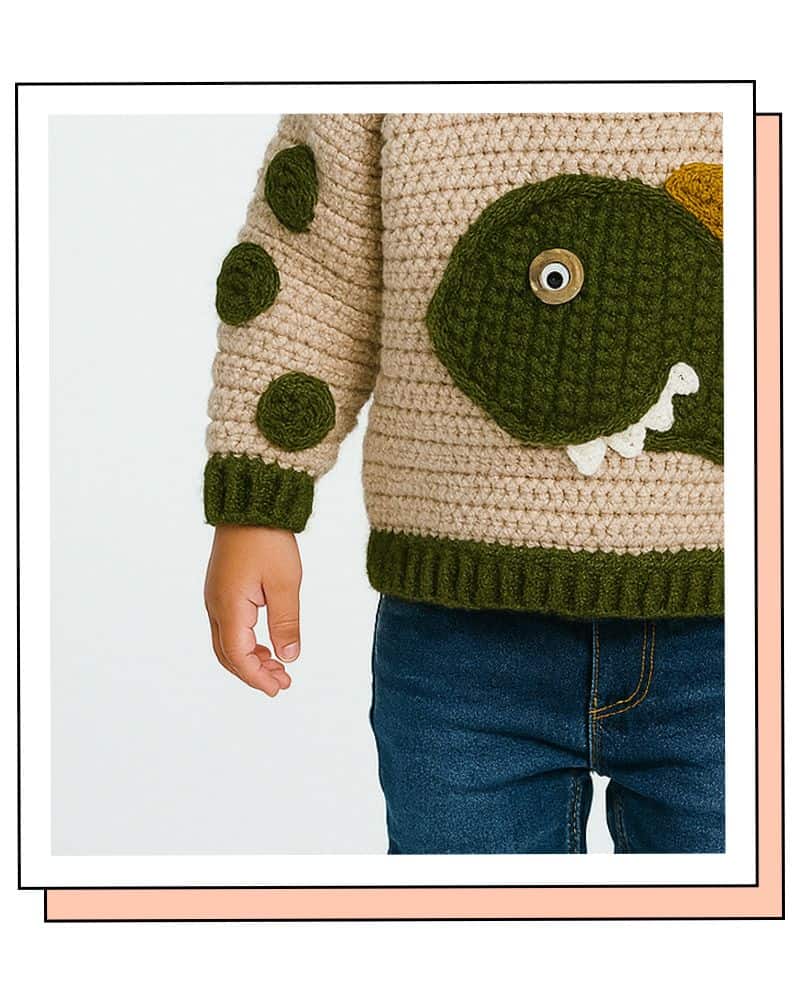
This is the bit I most wanted to show you. I took a photograph of one of my own crochet garments (the Crochet Dinosaur Jumper) and gave it to an AI image tool with a simple request: show this on a model. Here’s my original next to what came back.
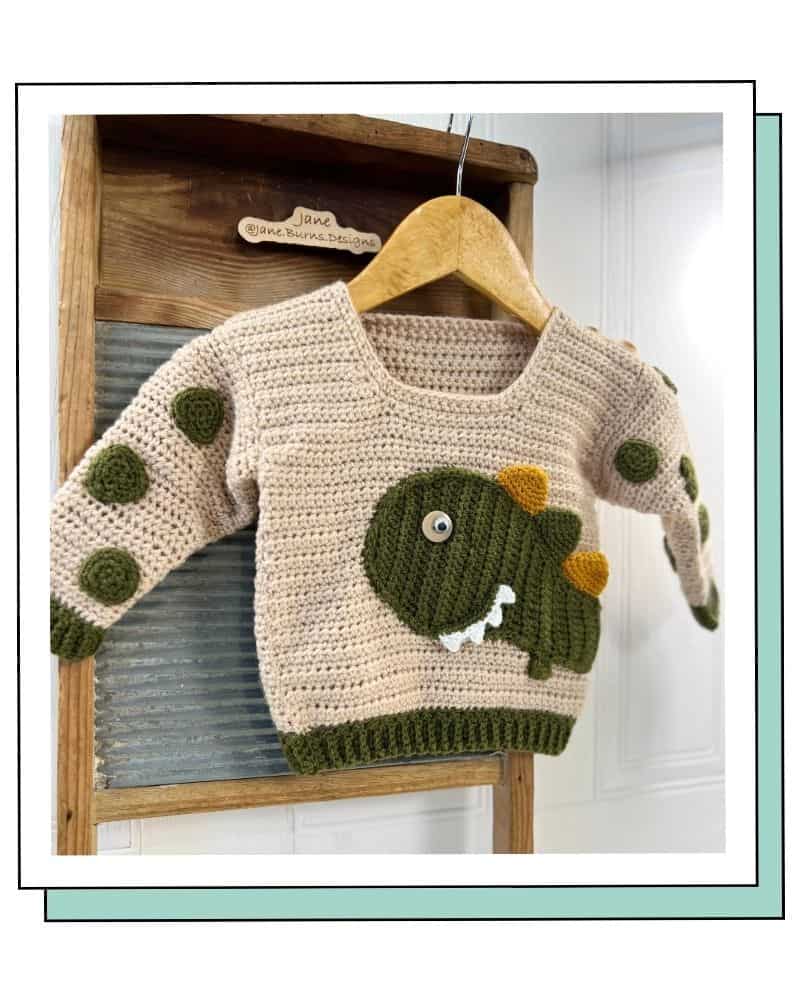
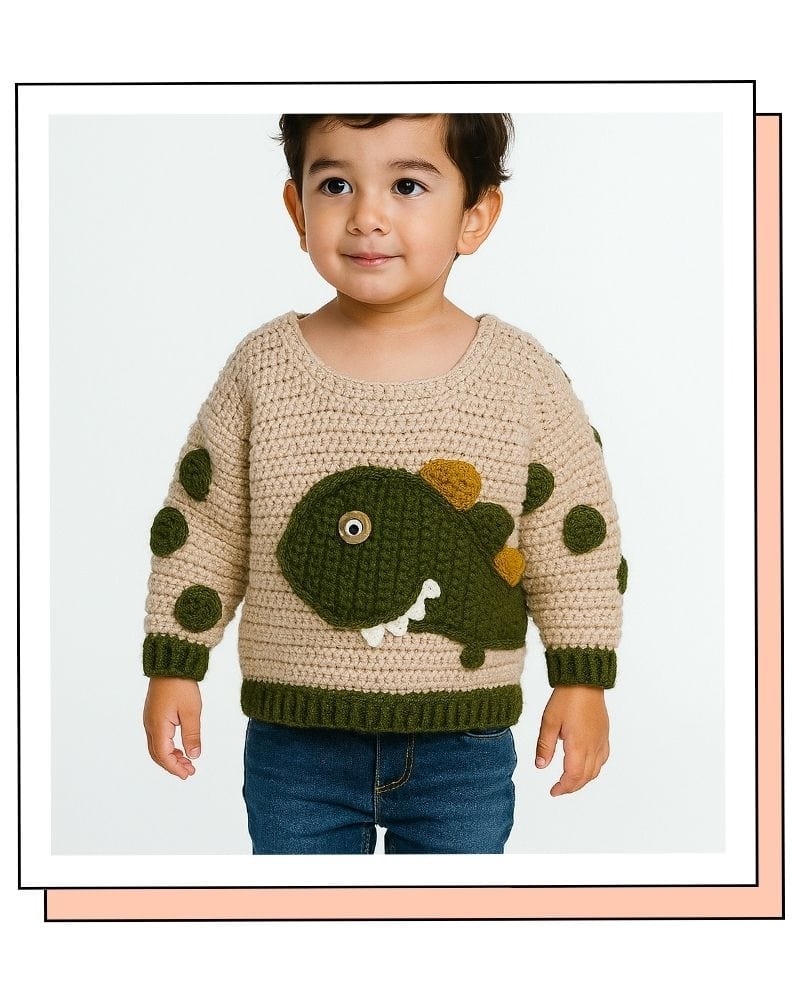
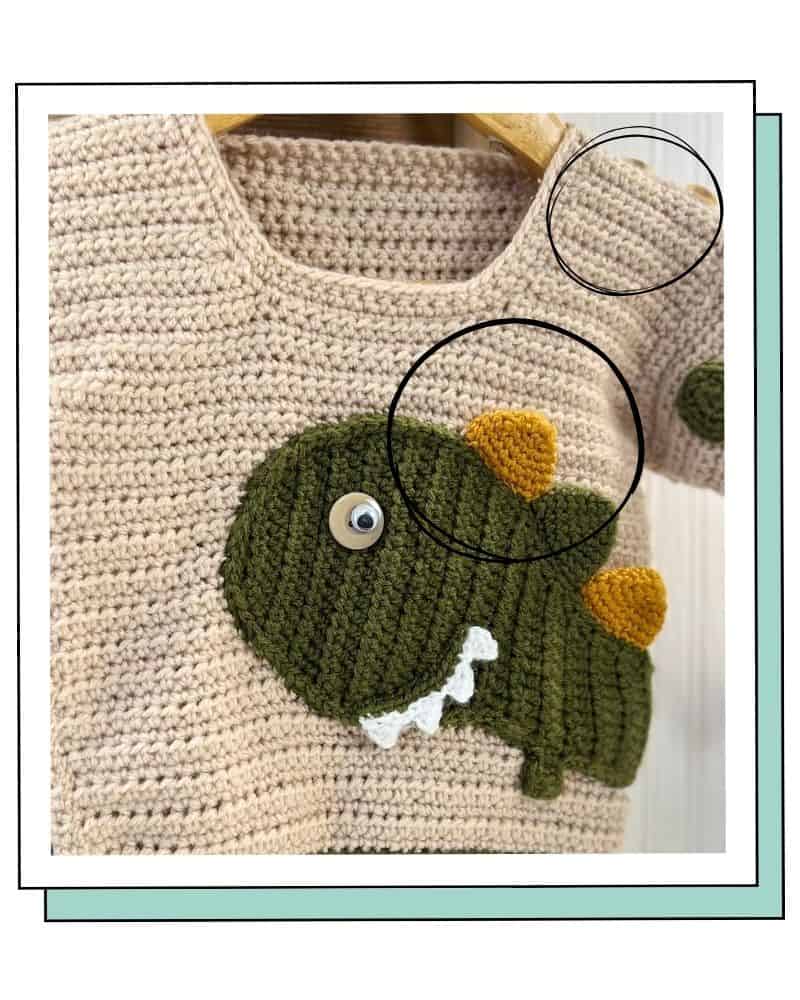
At a glance they look the same. Look closer and the AI version has quietly changed things:
- The stitches. Real crochet has texture and shadow, and every stitch is slightly different. The AI stitches are smoother, flatter and more regular, almost as if they’ve been printed on.
- The edges and details. The buttons have vanished. But the biggest tell is the detail in the small elements, the circle spots have lost all definition. The spikes are a triangle blob. Of course, you won’t have a genuine garment photo to compare, but if you cannot clearly see the finer details, particularly in small pieces, you are likely looking at an AI-generated image.
- The shape. Proportions shift to flatter the model rather than to show you the garment honestly.
Now imagine that someone sells a pattern using the AI picture. Even if the instructions were perfect, which they won’t be, you could never make what’s in the photo, because the photo isn’t a real garment. It’s a guess at one.
The same happens with knitting. AI doesn’t understand how a stitch is formed, so it can’t draw one honestly. That’s your biggest advantage: you do understand, even if you’ve never put it into words.
How to Spot AI Knitting Patterns: 8 Red Flags
One red flag on its own proves nothing. Plenty of genuine patterns have a so-so photo or a small error. But when three or four turn up together, put your purse away.
1. The photos are too perfect, or impossible
Real knitting is a little fuzzy. It has stray fibres, slightly uneven tension and shadows where the fabric folds. AI knitting looks smoothed, glossy and too regular. Look for cables that go nowhere, colourwork that melts into the background, and garments with no visible seams, edges or cast-on.
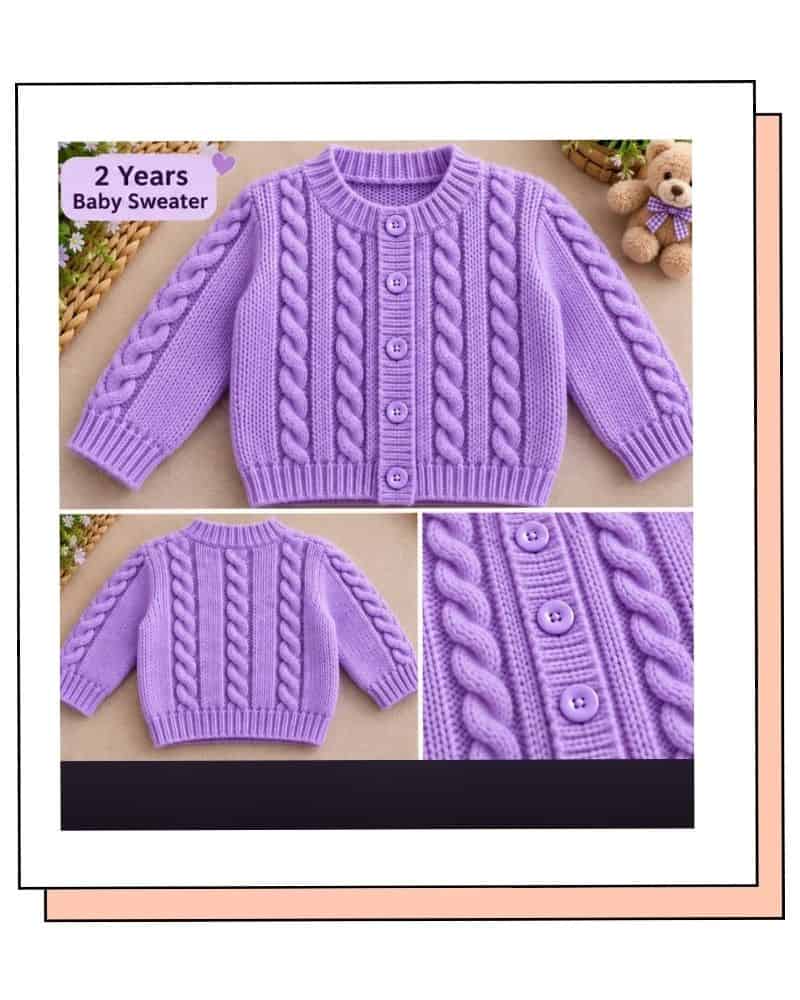
Things to pay attention to: the button band does not appear to be connected to the garment either side. The buttons lay perfectly flat on the garment and the buttonhole stitches around the buttons are perfectly straight. Note too that there are 3 stitches in the stocking stitch section between the cables…
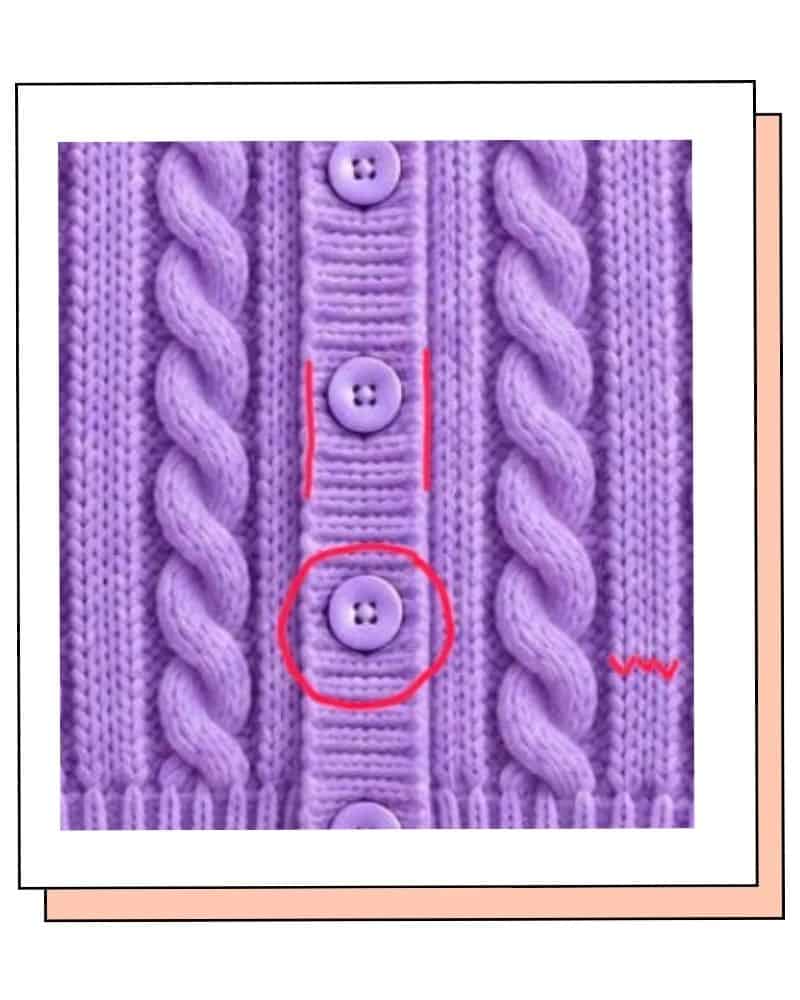
In the comments on this Facebook post somebody pointed out this was AI-generated, only to receive a reply from the ‘designer’ saying they knit everything, with an image attached to prove it (erm, wait, what?).
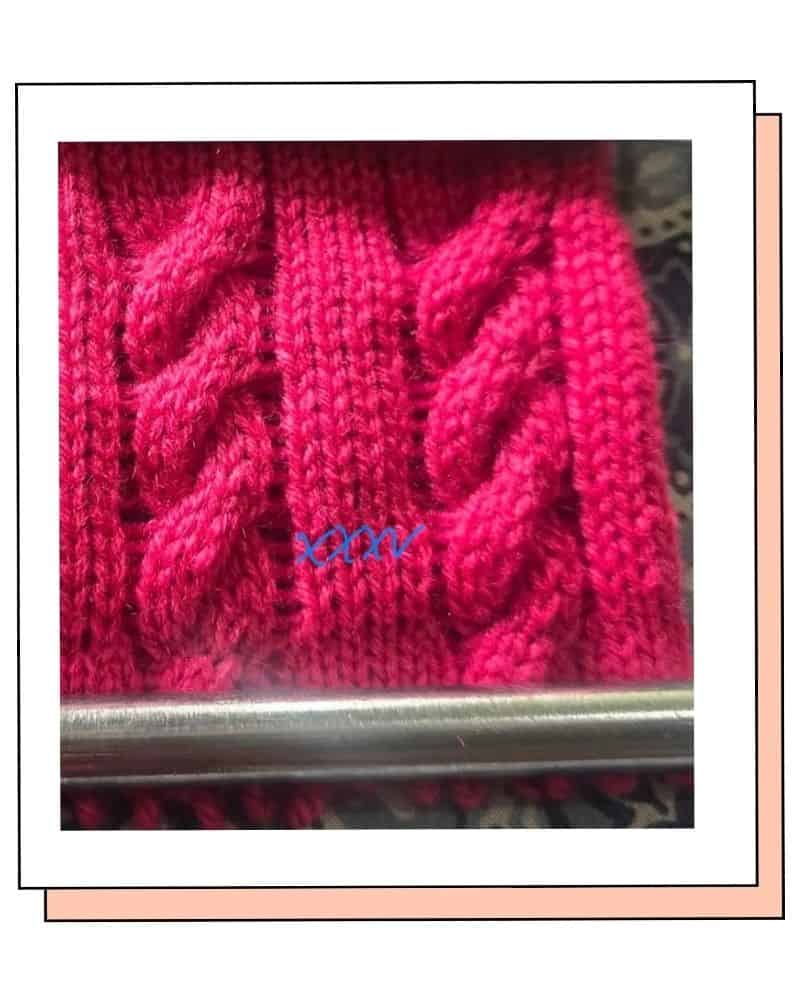
You do not need me to point out every way in which this swatch does not match the garment, but at a quick glance you will note there are 4 stitches in the stocking stitch sections, rather than the 3 in the ‘pattern’.
2. The babies look wrong
This one is close to my heart, because babies and children are all I design for. AI babies have a waxy, too-smooth look. Count the fingers. Look at where the cardigan ends and the baby begins, because in AI pictures they often blend into each other. A real baby in a real knit is usually wriggling, slightly crumpled and not quite looking at the camera. AI-generated models often have the same hand positions, too.
3. The sizes don’t match real children
A proper pattern sizes its garments to real body measurements. A 12-month-old, for example, has a chest of around 18in (46cm) on the Craft Yarn Council’s standard size chart. If a pattern’s finished measurements wouldn’t fit the child it claims to fit, or it gives an age with no measurements at all, be wary. My baby and children’s knitting size guide lists the measurements you should expect to see, so you can check any pattern against it.
4. The basics are missing or don’t add up
Every real pattern tells you the yarn weight, how much yarn you need, the needle or hook size and the tension (gauge). AI patterns often leave one out, or give numbers that don’t fit together, such as a chunky yarn on tiny needles, or a blanket that somehow needs one ball. Read the materials list as a knitter. If it sounds wrong to you, it probably is.
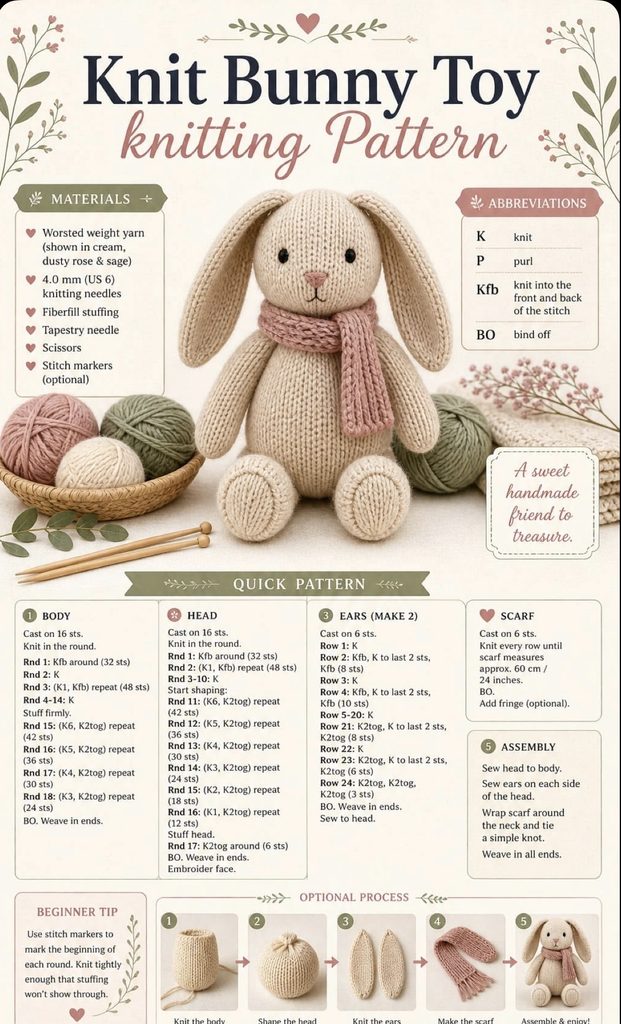
Pinterest and Facebook are littered with tempting patterns like this ‘freebie’. An overly polished finished item with impossible shaping is the immediate red flag. Missing are the instructions for the arms and legs. I wanted to be thorough, so I headed off to the website to see if the entire pattern was available, and found another version of the pattern that is 6 lines long. Why do people create these ‘patterns’? Well, they take you to a website where you hope to find the pattern, you scroll and scroll being shown lots of adverts. These adverts are where they earn the money and steal your time.
5. The stitches can’t be named
Look at the photo and ask yourself what stitch it is. With a real pattern you can usually tell: garter, moss, cables, granny squares, linen stitch. AI images often show textures that don’t belong to any stitch you know. In crochet especially, look for stitches that seem to grow out of nowhere, or a fabric that looks knitted and crocheted at once.
6. The price is a bargain bundle
Designing, testing and writing one pattern takes weeks. Nobody can do that for a hundred patterns and sell them for £3. A huge bundle at a tiny price is a sign the patterns cost nothing to make.
7. There’s no designer trail
Search for the designer’s name. A real designer turns up somewhere: a website, a Ravelry page, magazine credits, a newsletter, years of social media posts. Not every designer is famous, and some are new, but every real one leaves footprints. If you find nothing at all, that tells you something.
8. The reviews tell the story
Read the words, not just the stars. Reviews that mention confusing instructions, a finished item that looks nothing like the photo, or the phrase “I think this is AI” are worth more than a page of five-star ratings. On Ravelry, check the projects tab too. Real patterns have real knitters’ photos.
Your Free Checklist: How to Spot AI Knitting Patterns
I’ve put all eight red flags, plus the Facebook warning signs and the designer checks, onto one printable page. Keep it next to your laptop, tuck it into your project bag, or pass a copy to a friend who’s just started knitting.
Before you go, grab the free printable checklist. It does the remembering for you, so the next time a too-good-to-be-true pattern turns up, you’ll know exactly what to look for.
How to Check a Designer Was Working Before AI
The simplest test of all is time. The AI tools that can produce a convincing pattern and picture became widely available at the end of 2022. A designer who was publishing patterns before then built their work the old-fashioned way. That doesn’t make every older pattern perfect, but it does mean a real person made it.
You don’t need to be a detective to check. Try these:
- Ravelry. Every pattern page shows when it was published. Click through to the designer’s page and scroll to their oldest patterns.
- Magazine credits. If you’ve seen a designer’s name in Let’s Knit, Simply Knitting or another magazine from years ago, that’s someone with a real track record.
- Social media. Scroll back through their Facebook or Instagram. Real designers have years of posts: works in progress, yarn they’ve been sent, the odd disaster.
- Their website. Look for an About page with a real person on it, real photos of them at work, and real contact details.
For what it’s worth, here’s my own trail. My first commission was in 2008. Since then my designs have appeared in most of the major UK knitting magazines, I’ve contributed to The Official Beatles Knitting Book, appeared on Create and Craft TV, and designed for yarn companies including King Cole, Scheepjes and Eden Cottage Yarns. I’ve also designed licensed patterns for Snoopy, The Beatles, The Clangers, The Moomins and Wallace and Gromit. You can check all of it, which is rather the point.
Why a Real Photo Can Carry an AI Label
Here’s a complication worth knowing about. You may see a small “AI info” label on a Facebook or Instagram photo, or “AI modified” on Pinterest, sitting on a picture from a designer you trust. It doesn’t necessarily mean the knitting is fake.
These labels are applied automatically, and they can’t always tell the difference between an AI picture and a real photograph that’s been tidied up. In 2024, after photographers complained that genuine photos were being tagged, Facebook and Instagram changed their label from “Made with AI” to the vaguer “AI info”. Pinterest added its own “AI modified” labels in 2025 and lets creators appeal when they get it wrong.
Ordinary editing can be enough to set them off. Here’s what I do with my own photos, and why it’s nothing to worry about.
I use Canva as my desktop publishing program, now that Microsoft Publisher is no longer supported. It’s where I lay out my patterns, add text to images, make my social media posts and edit videos. It’s also where I tidy up photos, which sometimes means removing a cluttered background so you can see the knitting properly. Years ago I did exactly the same job in Photoshop. The knitting in the photo is real. The garden fence behind it has simply gone.


So treat a label as a reason to look closer, not as a verdict. Run through the red flags above. A real designer’s photo will pass every one of them, label or no label.
When Even Familiar Names Use AI Images
I’ll be honest about why this matters to me personally. Let’s Knit commissioned my very first design back in 2008, so I was disappointed to see the magazine’s Facebook page using AI-generated images of knitted items. Some of these had clearly been knitted, and some had been ‘polished’ using AI to make them more appealing. I cannot understand the thinking behind this. Surely anyone who knits that gonk pattern is only going to be disappointed when their project does not look like the picture. Why not use the image below?
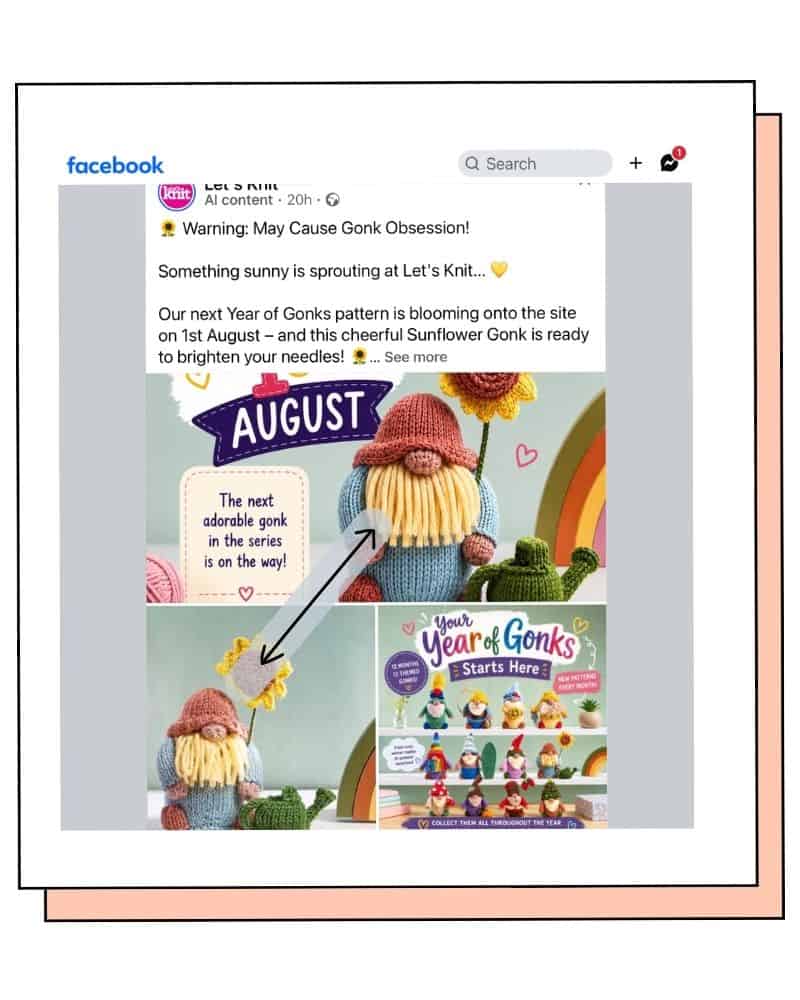
I’m not telling you this to pile on. I’m telling you because it shows that the familiar names aren’t automatically safe. If a knitting magazine can post a picture polished beyond anything you could actually knit, anyone can. Use the red flags on everyone, including the people you trust, including me. A genuine designer won’t mind in the slightest.
How You Can Help Protect Your Community and the Designers You Love
You don’t need to become an internet detective to make a difference. Two small habits do more good than you’d think.
Don’t feed the fakes
When you spot an AI post on Facebook, the temptation is to comment and warn everyone. Please don’t. Every comment, even “this is AI!”, tells Facebook the post is interesting and shows it to more people. You end up giving it the very air time it was after. Scroll past, or use Facebook’s own report button if you’d like to do something, and leave the comments empty.
Show some love to the real ones
Real designers are having a hard time competing with the data-farming pages, which post far more often than any human with needles can. The algorithm rewards whoever gets the most likes and comments, so take the time to like, comment on and share posts from the designers you love. It costs nothing, it really does help them be seen, and it will quite genuinely make their day. To all of those of you who do these things already, thank you.
What I Use and What I Don’t
What I use
- Knitting needles, crochet hooks and a lot of yarn
- A camera, for photographing every finished piece myself
- Canva, for laying out patterns, tidying photos (including removing backgrounds), adding text, making social media posts and editing video
What I don’t do
- Use AI to create designs
- Use AI to generate pictures of knitting or crochet that doesn’t exist
- Sell a pattern for anything I haven’t made with my own hands
Frequently Asked Questions
How can you tell if a knitting or crochet pattern is AI?
Look for several warning signs together: photos that are too smooth or physically impossible, sizes that don’t match real body measurements, missing basics such as tension and yarn amounts, bargain bundles, no trace of the designer anywhere else, and reviews saying the pattern doesn’t work.
Do AI knitting patterns actually work?
Very rarely. AI can copy what a pattern looks like, but it can’t count stitches, check shaping or knit a sample. Most AI patterns contain errors that make them impossible to finish as pictured, which is why so many knitters blame themselves.
Does Ravelry allow AI patterns?
Ravelry removes obviously AI-generated patterns, and its community is quick to report them. Its project pages are one of the best checks there is, because real patterns have photos of real knitters’ finished projects.
Why do Facebook and Pinterest label real photos as AI?
The labels are applied automatically and can be triggered by ordinary photo editing, such as removing a background. Treat a label as a reason to look more closely, not as proof that a pattern is fake.
Is editing photos in Canva the same as using AI to make them?
No. Tidying a real photograph, adding text or removing a background is the same job designers once did in Photoshop. The knitting in the photo is still real. An AI image shows knitting that has never existed.
What should I do if I’ve bought a fake pattern?
Ask the seller or the platform for a refund, and leave an honest review describing what went wrong so other knitters are warned. If the photos look stolen from a real designer, let that designer know. Most of us can’t spot every copy ourselves, and a message from a knitter makes a real difference.
The One Thing to Remember
If a pattern won’t work, it isn’t always you. Sometimes there was never a pattern there at all.
Knitting and crochet have always been passed from one pair of hands to the next, and a pattern is simply a written version of that: someone who has made the thing, telling you how. Choose designers whose hands you can trace. If you’d like to start with something I’ve knitted, sized and photographed myself, my guide to knitting for babies is a good place to begin.
About Jane Burns
Jane Burns has been designing knitting and crochet patterns professionally for 18 years. Her work has appeared in the major UK knitting magazines and on Create and Craft TV, she has contributed to The Official Beatles Knitting Book, and she has designed for King Cole, Scheepjes and Eden Cottage Yarns, as well as licensed patterns for Snoopy, The Beatles, The Clangers, The Moomins and Wallace and Gromit. Every design is made and photographed by Jane herself.
Visit the shop · Read more about Jane
Stay in Touch
If you would like new patterns, free resources, and the occasional dry observation about knitting for children delivered straight to your inbox, you can join the list here: