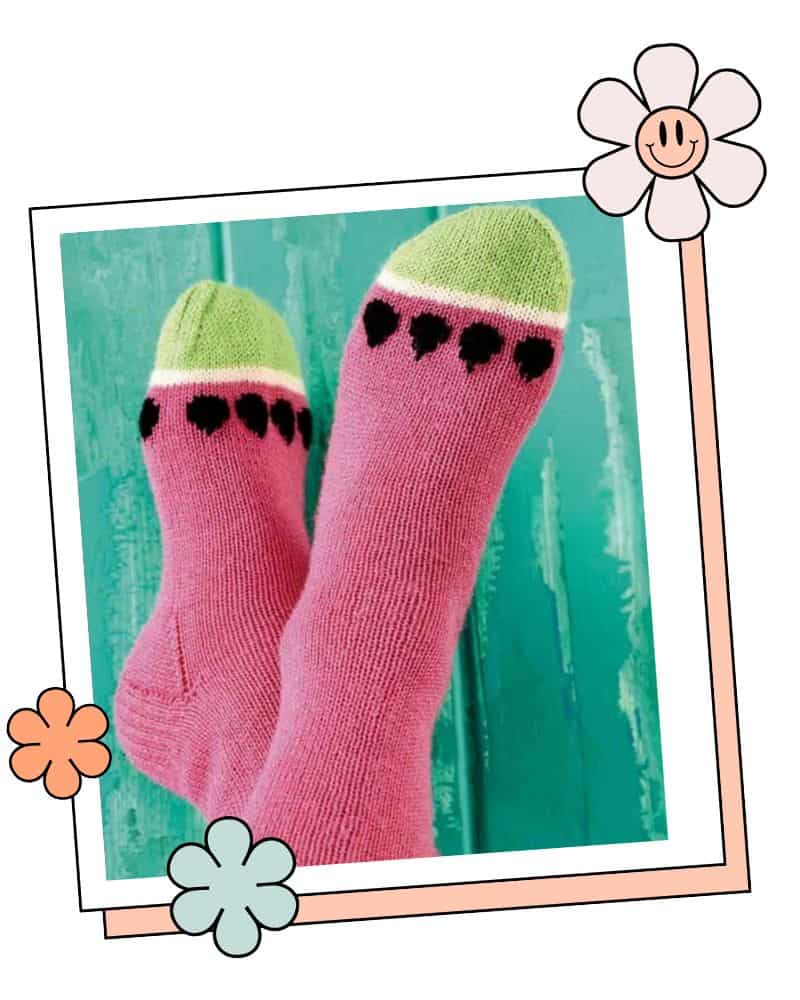
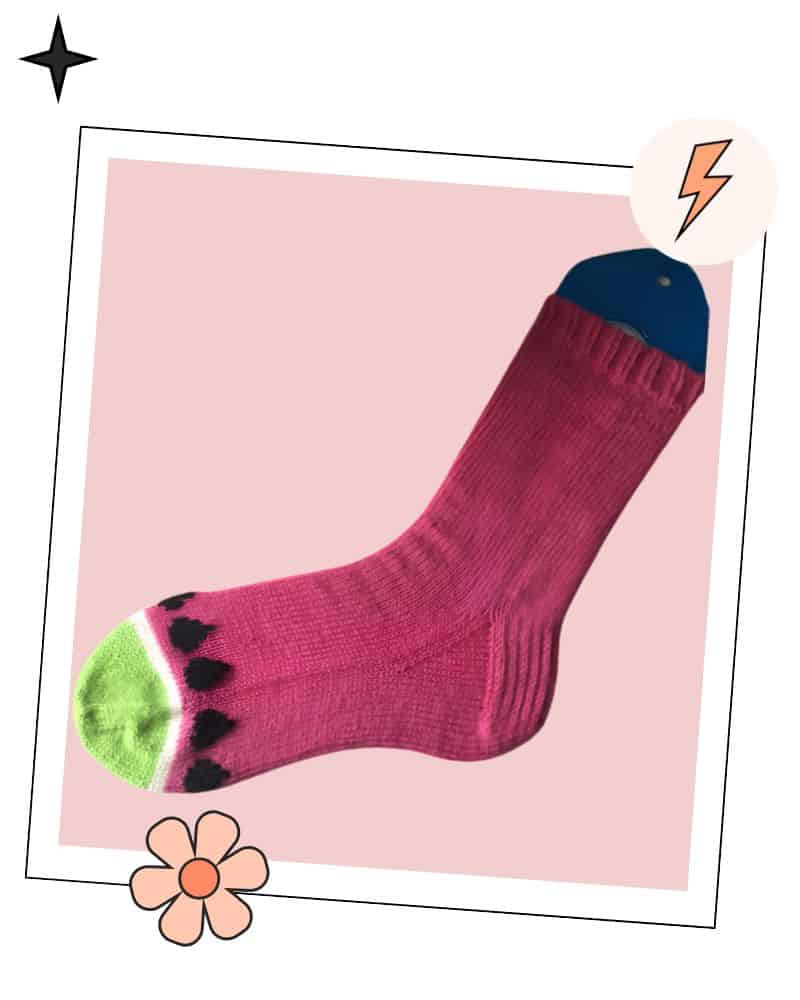
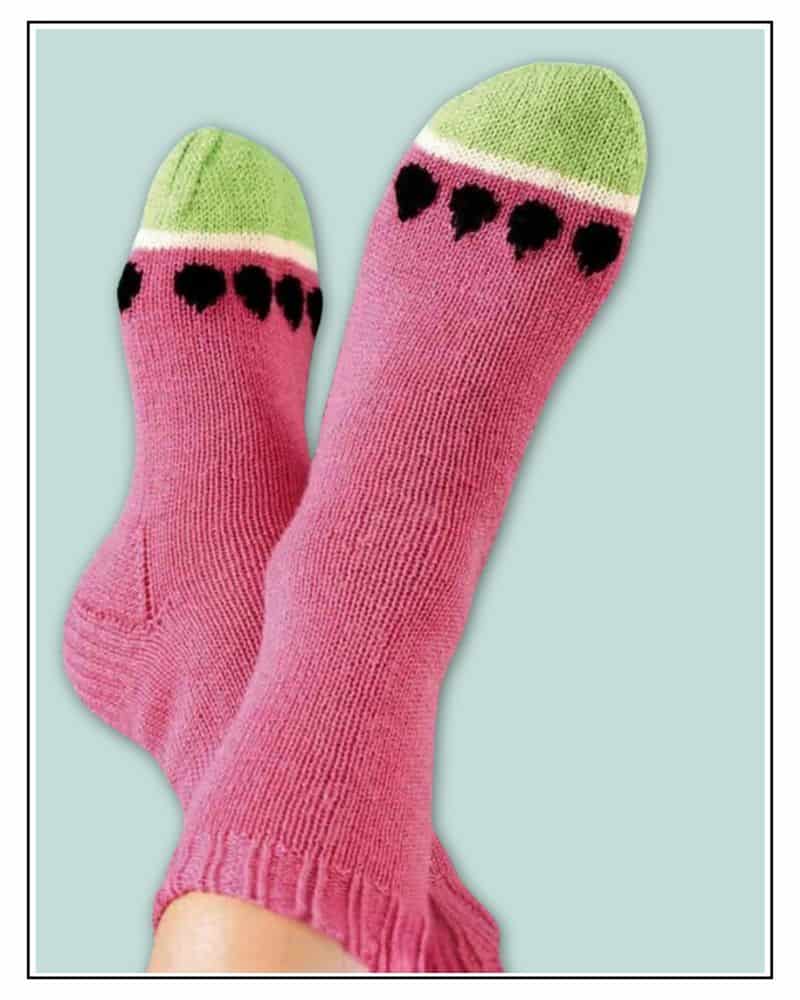
If your sock drawer could do with a bit of summer, this is your sign. These watermelon socks are worked top down in 4ply / fingering weight yarn with a heel flap and gusset, a small stranded colourwork section for the pips, and a colour block toe that looks far more complicated than it is. Three sizes, clear instructions, and a great excuse to dig into your stash.
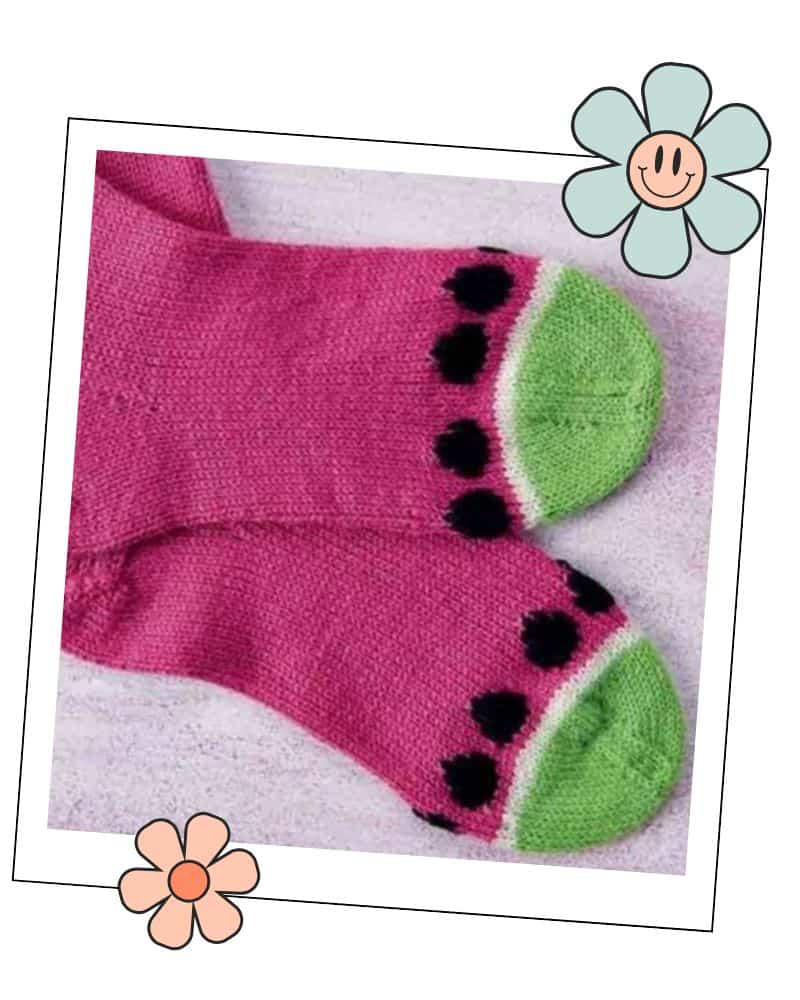
Meet the Watermelon Socks. These are one of those patterns that just makes people smile. Pink sock, green toe, little black pips, they are unmistakably a watermelon, and unmistakably brilliant.
What kind of construction are the Free Watermelon Socks, Knitting Pattern?
The Free Watermelon Socks knitting pattern is a top-down sock pattern with a heel flap and gusset construction. If you have knitted socks before, you will find this very familiar. If these are your first socks, the heel flap and gusset method is a solid, well-established technique that gives an excellent fit, and the pattern includes clear, step-by-step instructions throughout.
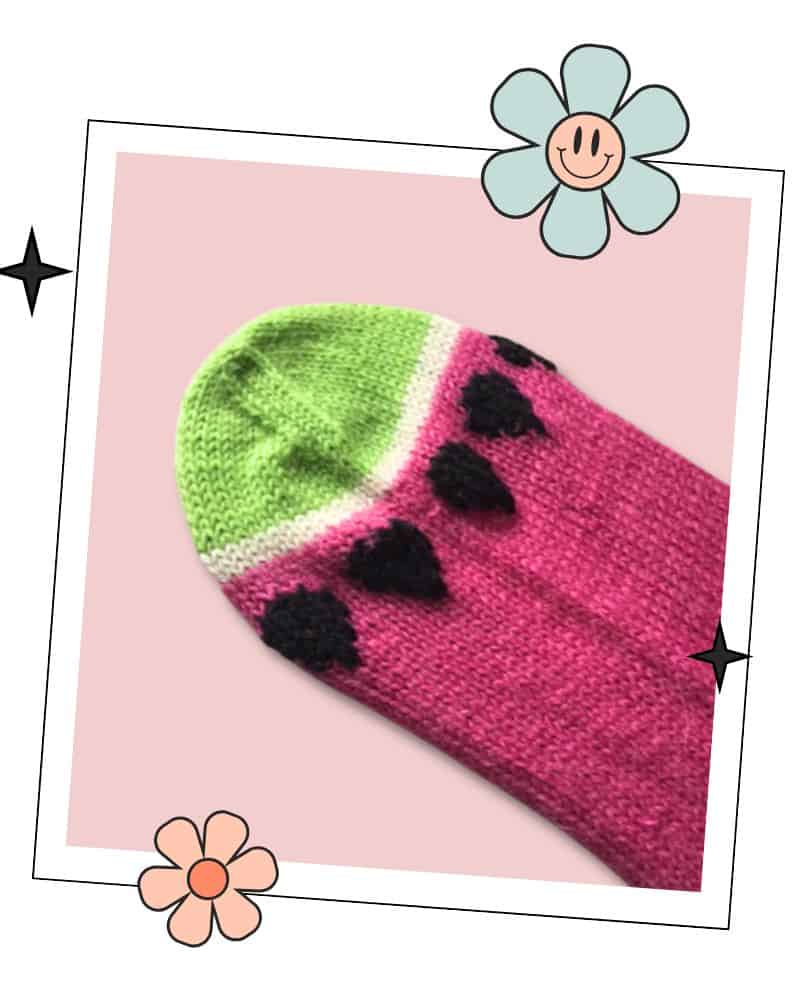
The only point that needs a little thought is the watermelon pip section, which uses simple two-colour stranded colourwork. It covers just seven rows and uses only two colours at once, so this is a genuinely good first stranded colourwork project if you have been curious about the technique but not yet tried it.
Not ready for stranded colourwork just yet? No problem. The pips can be added using Swiss darning (also known as duplicate stitch) after the foot is complete. Just make sure you add them before you work the toe shaping. The finished result is identical, and Swiss darning gives the pips a very slightly raised texture, which is rather nice.
What you will need
Yarn: Any 4ply / fingering weight yarn with a nylon content, approx. 400m per 100g.
The pattern was originally designed using West Yorkshire Spinners Signature 4ply, which is a joy to work with. But I have added some option for you which you will find below.
You will need four colours:
- Yarn A — main colour (pink / watermelon flesh)
- Yarn B — a small amount of white or off white for the stripe
- Yarn C — green for the toe
- Yarn D — black or very dark for the pips
Yarns B, C, and D use very small amounts — approximately 10g of C and D, and just 5g of B. This is an excellent stash-busting pattern.
Yarn Suggestions:
West Yorkshire Spinners, Signature 4ply 75% Fine Superwash Merino / 25% Nylon (100g -425m/400yds)
- 234 Honeysuckle x 1 ball
- 010 Milk Bottle x 1 ball
- 395 Chocolate Lime x 1 ball
- 099 Liquorice x 1 ball
Drops Fabel Unicolour, 75% wool / 25% polyamide (50g – 105m/114 yds)
- Shade 102 Pink x 2 balls
- Shade 100 Off White x 1 ball
- Shade 118 Parrot Green x 1 ball
- Shade 400 Black x 1 ball
*Contains affiliate links which help support my blog
Knit Picks, Stroll Fingering 75% Fine Superwash Merino Wool / 25% Nylon (50g – 210m/230 yds)
- Shade Pucker x 2 balls
- Shade White x 1 ball
- Shade Peapod x 1 ball
- Shade Black x 1 ball
Needles: 2.5mm double-pointed needles or a 60–80cm circular needle for magic loop.
Also needed: Stitch markers, darning needle.
Tension: 34 sts x 44 rows over 10cm in stocking stitch using 2.5mm needles.
Sizes
| Measurement | Small | Medium | Large |
|---|---|---|---|
| Finished foot circumference | 17cm / 6.75in | 18cm / 7in | 19cm / 7.5in |
| To fit foot circumference | 20cm / 8in | 21cm / 8.25in | 22cm / 8.5in |
Abbreviations
You will need the following abbreviations for this pattern. If you need a full reference guide, you can download the free Knitting Abbreviations Guide here: https://shop.janeburns.co.uk/products/free-knitting-abbreviations-guide-essential-reference-for-all-jane-burns-patterns
k — knit, p — purl, k2tbl — knit 2 through back loop, sl1 — slip 1 stitch, ssk — slip slip knit, k2tog — knit 2 together, p2tog — purl 2 together, PM — place marker, SM — slip marker, RS — right side, WS — wrong side, rnd — round, rem — remaining, sts — stitches.
Pattern notes
The free Watermelon socks knitting pattern use a very small amount of Yarns B, C and D, making them a great stash buster. Whilst the pattern is written for stranded knitting for the seeds, it is possible to Swiss darn the seeds on at the end, giving them a nice slightly raised texture. If you choose to Swiss darn, work this section before starting the toe shaping. You could also add more seeds up the leg if you desire.
Want the PDF Version?
Socks are a project you pick up and put down, often in awkward places with yarn-covered fingers and a screen that keeps going to sleep. The PDF version of these watermelon socks is formatted for printing or saving to your device, so the pattern is right there when you need it, without the scrolling.
Get the PDF here
The Pattern Free Watermelon Socks Knitting Pattern
Cast on and Cuff
Using long tail cast on, 2.5mm needles and Yarn A, cast on 56 (60, 64) sts. Join into the round taking care not to twist. Place marker for beginning of round.
Round 1: *K2 tbl, p2; rep from * to end.
Repeat Round 1 until cuff measures approx. 2.5cm / 1 in.
Leg
Round 1: Knit.
Continue knitting every round until leg measures 18cm / 7 in (or desired length).
Heel flap
Worked over next 28 (30, 32) sts using Yarn A.
Change to Yarn A if you have been working a contrast colour.
With RS facing, work back and forth as follows:
Row 1: *Sl1 purlwise, k1; rep from * to end. Row 2: Sl1 purlwise, purl to end.
Repeat these 2 rows until 26 (30, 32) rows are complete.
Turn heel
Row 1: K15 (16, 17), ssk, k1, turn.
Row 2: Sl1, p3, p2tog, p1, turn.
Row 3: Sl1, k4, ssk, k1, turn.
Row 4: Sl1, purl to one stitch before gap, p2tog, p1, turn.
Row 5: Sl1, knit to one stitch before gap, ssk, k1, turn.
Continue as set until all sts are worked. You may need to omit the final k1 or p1 on the last two rows for some sizes. [16 (16, 18) sts]
Heel gusset
With RS facing, knit across heel flap sts, pick up and k13 (15, 16) sts along the side of heel, pick up and knit one stitch at corner from row below to prevent hole, PM, knit across 28 (30, 32) instep sts, PM, pick up and knit one stitch at corner from row below to prevent hole, pick up and k13 (15, 16) sts along side of heel, knit across 8 (8, 9) heel sts. Place marker for new beginning of round. [72 (78, 84) sts]
Shape gusset
Round 1 (decrease round): Knit to three sts before marker, k2tog, k1, SM, knit instep even over next 28 (30, 32) sts, SM, k1, ssk, knit to end. [Two sts decreased]
Round 2: Knit to marker, SM, knit instep sts, SM, knit to end.
Repeat Rounds 1 and 2 until 56 (60, 64) sts remain.
Foot
Knit to start of instep, this is now the new beginning of round.
Continue knitting every round until foot measures 7.5 (8, 8) cm / 3 (3.25, 3.25) in less than finished foot length.
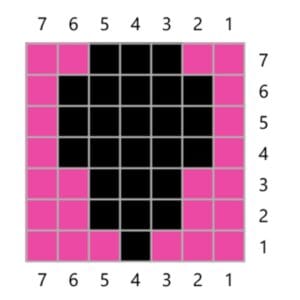
Commence working from Chart:
Round 1: *Work Row 1 from Chart twice, k0 (2, 4), work Row 1 from Chart twice; rep from * once more.
Rounds 2–7: Work from Chart as set.
Rounds 8–10: Knit.
Change to Yarn B.
Rounds 11–13: Knit.
Change to Yarn C.
Continue knitting every round without decreasing until foot measures 3 (3.5, 3.5) cm / 1.25 (1.5, 1.5) in less than desired foot length.
Colourwork chart
Want the PDF Version?
Socks are a project you pick up and put down, often in awkward places with yarn-covered fingers and a screen that keeps going to sleep. The PDF version of these watermelon socks is formatted for printing or saving to your device, so the pattern is right there when you need it, without the scrolling.
Get the PDF here
Shape toe
Round 1 (decrease round): *SM, k1, ssk, knit to 3 sts before marker, k2tog, k1, SM; rep from * once more. [Four sts decreased]
Round 2: Knit, slipping markers.
Repeat Rounds 1 and 2 until 36 (40, 44) sts remain in total.
Next: Work decrease round only until 20 (20, 20) sts remain.
Finishing
Slip all instep sts onto one needle. [10 (10, 10) sts] Slip all heel / sole sts onto another needle. [10 (10, 10) sts] Holding two needles together, graft sts using Kitchener Stitch.
Weave in ends. Block lightly if desired.
Want the PDF version?
The premium PDF download includes the full pattern formatted for printing, colourwork chart, yarn requirement notes, sizing in both cm and inches, and a tip on Swiss darning. Clear to follow and easy to print.
Available to purchase here:
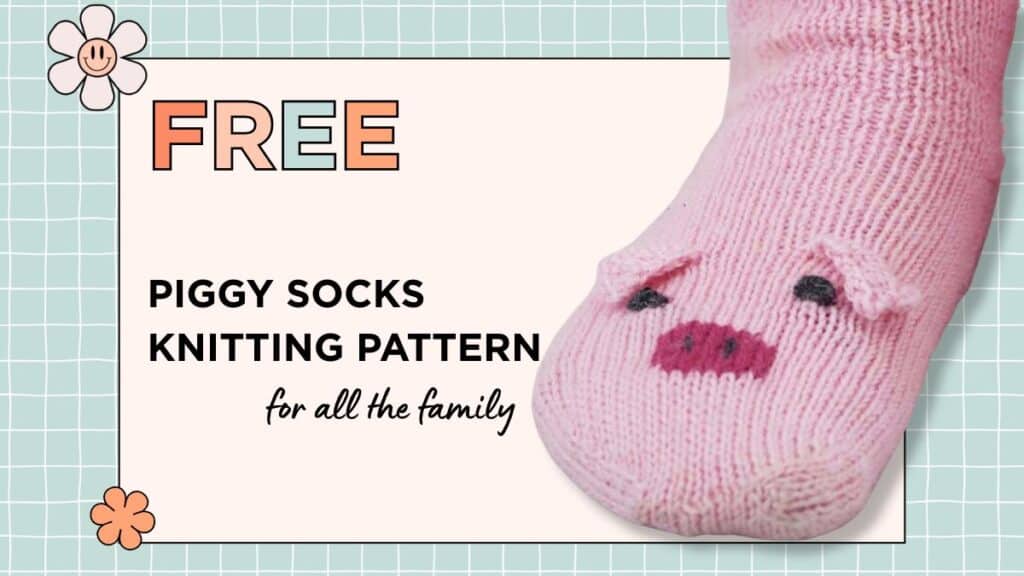
Love knitting socks for the family? Check out my Piggy Socks
Share Your Watermelon Socks
If you make knit these super cute socks, I would love to see them. Share your finished socks on Instagram and tag @jane.burns.designs, #janeburnsdesigns, or leave a comment below.
If you enjoyed this pattern, sharing the pin below helps other knitters find it too.
Jane
FAQs
Do I need to know how to knit socks to make these?
It helps if you have knitted a pair of socks before, but it is not essential. The pattern includes clear, step-by-step instructions throughout. If you are new to sock knitting, the heel flap and gusset method used here is one of the most widely used sock constructions, and there are lots of good video tutorials available online to support you.
Can I use circular needles instead of double-pointed needles?
Yes. The pattern works equally well on 60–80cm circular needles using the magic loop method.
I have never done stranded colourwork before. Is this suitable for me?
The colourwork section covers just seven rows and uses only two colours at once, making it a great introduction to the technique. Alternatively, you can add the pips using Swiss darning after the foot is complete. Just make sure you work the Swiss darning before starting the toe shaping.
What is Swiss darning?
Swiss darning, also known as duplicate stitch, is a technique where you use a tapestry needle to sew over existing stitches and add colour on top of the finished knitting. It mimics the look of stranded colourwork and gives the pips a slightly raised texture.
Can I add more pips up the leg?
Yes, absolutely. The pattern notes mention this as an option. Work additional pip repeats wherever you like on the leg section.
What yarn weight do I need?
4ply, also known as fingering or sock weight. The pattern works best with a yarn that contains some nylon for durability, especially in the heel and toe areas. Any 4ply sock yarn with approximately 400m per 100g will work well.
You might also like:
- Baby & Children’s Knitting Size Guide — chest, foot, and head measurements from newborn to 11 years
- Free Bumble Bee Baby Booties Knitting Pattern — a quick DK baby bootie make, sizes newborn to 18 months
- Knitting for Babies and How to Get It Right — yarn choices, construction, and everything to know before you cast on
About Jane
Jane is a UK based knitting and crochet pattern designer with 18 years of experience, specialising in whimsical, characterful patterns for babies and children. She is the founder of Jane Burns Whimsical Designs, with a focus on patterns that carry real personality, and on making knitting feel accessible, joyful, and a little bit daft when it needs to be.

Pattern by Jane Burns Whimsical Designs. © Jane Burns 2026. This pattern is for personal use only. Finished items may be sold in small quantities with credit given to Jane Burns for the design.