If you have ever worked from Jean Greenhowe knitting patterns, you will know how satisfying they are. Small pieces, simple shaping, a clean finish, and a project that looks far more complicated than it was. They are also, without most knitters realising it, some of the best knitting skills training you can do.
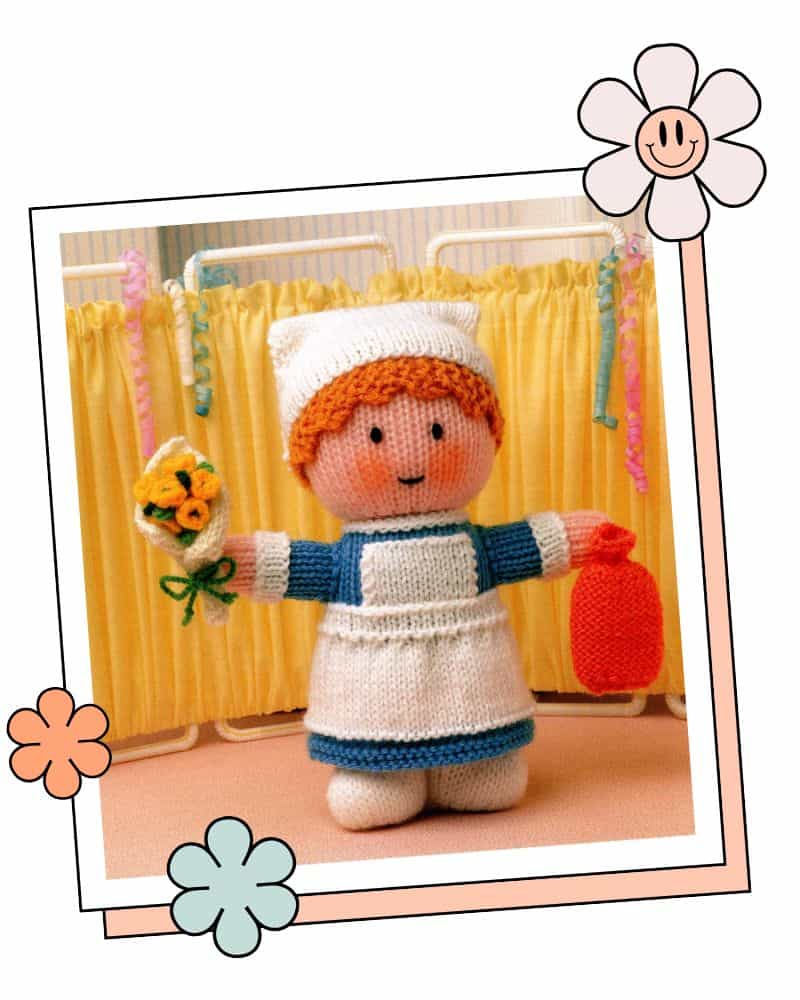
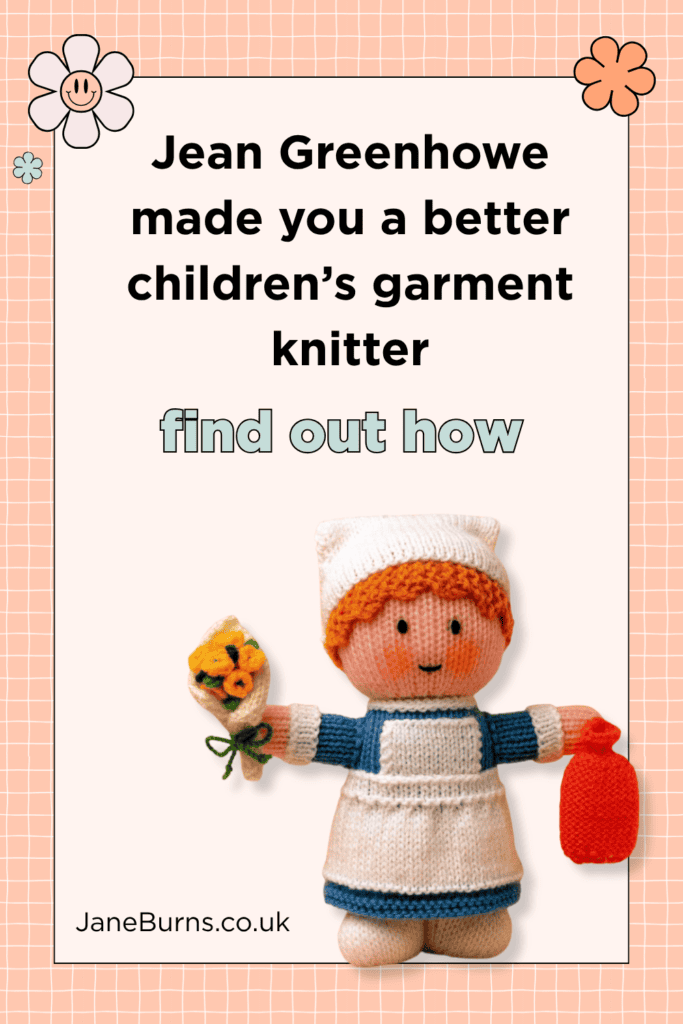
If you would like to try one of Jean’s patterns I highly recommend starting with her Nurse doll, you can find a FREE copy of the pattern here.
As a new knitter I learned so much from knitting those patterns. Before progressing onto the slightly more complicated Alan Dart patterns, whose work is so addictive it should probably come with a warning label. Jane, why are you telling me about these toy designers I hear you ask. Well, this post is about what toy knitting actually teaches you, and why those skills show up directly in children’s character garment design, including mine.
What Are Jean Greenhowe Knitting Patterns?
Jean Greenhowe was a British knitwear designer whose books and booklets were a fixture in UK craft shops from the 1970s through to the 2000s. Toys, Christmas figures, clowns, nativity scenes. You know the ones, clowns dressed as decorators and gardeners. Small quick knits with bags of character. Many of her patterns are still available today and still have a devoted following.
Alan Dart came from the same tradition. His toy knitting patterns appeared in magazines and as standalone publications, and he built a following among knitters who liked the combination of precise construction and a slightly eccentric result. If you know his work, you understand immediately. If you do not, look him up and clear your afternoon.
Why Toy Knitting Is Better Skills Building Than It Gets Credit For
People assume toy knitting is easier than garment knitting because the pieces are small. In some ways, yes. In others, it asks more of you. How so?
Small pieces are unforgiving
On a jumper, slight tension inconsistency disappears into the fabric. On a knitted toy head that is six centimetres across, it is the first thing you see. You learn to knit evenly because the finished object tells you honestly whether you did. Pesky toy stuffing popping through the stitches…
The shaping never stops
Jean Greenhowe patterns are full of increases and decreases worked every row or every other row. You cannot switch off. You learn to track your shaping and count your stitches, and after a while it becomes second nature.
Seaming is part of the design
A toy with poor seaming looks wrong regardless of how well it was knitted. Jean Greenhowe patterns taught a generation of knitters to seam neatly, attach limbs correctly, and embroider features with confidence. These are not finishing touches. They are structural skills.
You learn to think in three dimensions
A flat piece becomes a rounded shape. A tube becomes an arm. Knitting toys teaches you to visualise what knitted fabric will do when it is stuffed and seamed. That spatial understanding is directly useful when you are knitting a garment with 3D detail.
How This Shows Up in Children’s Character Garment Design
When I design a character children’s jumper or cardigan, I am doing almost exactly what Jean Greenhowe was doing, at a larger scale.
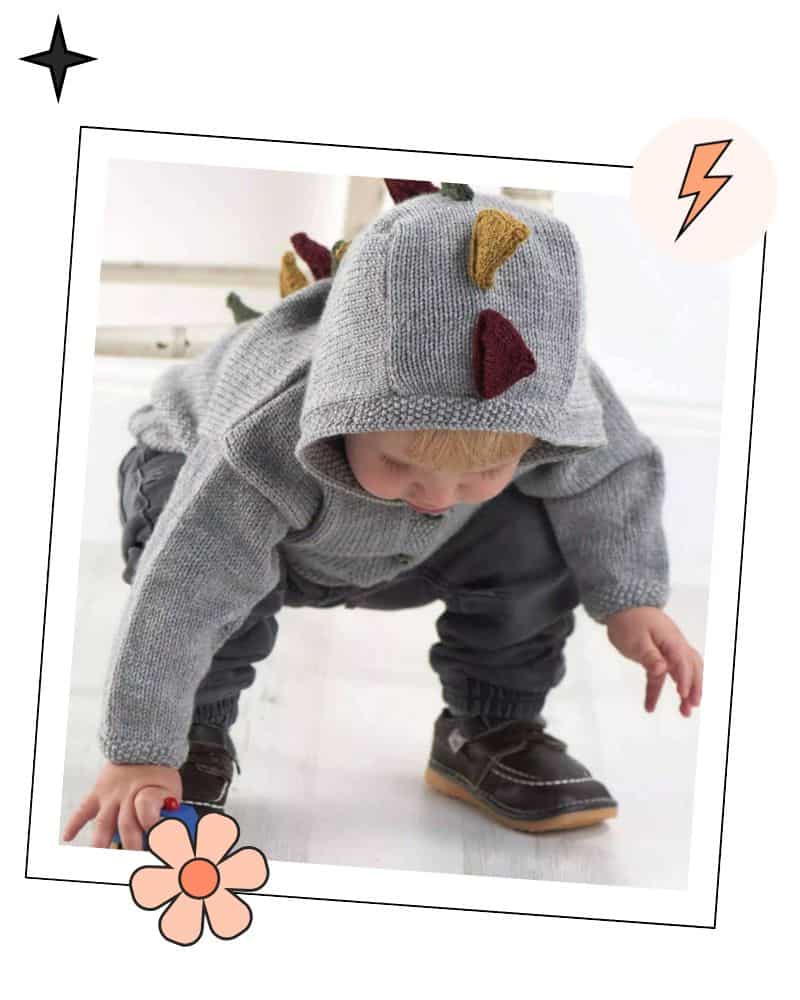
The Little Stegosaur Hoodie has dorsal spines along the back. Each one is a small, individually knitted piece, shaped, seamed, and attached. If you have never knitted a toy, those spines look daunting. If you have used any Jean Greenhowe knitting patterns, they look familiar.
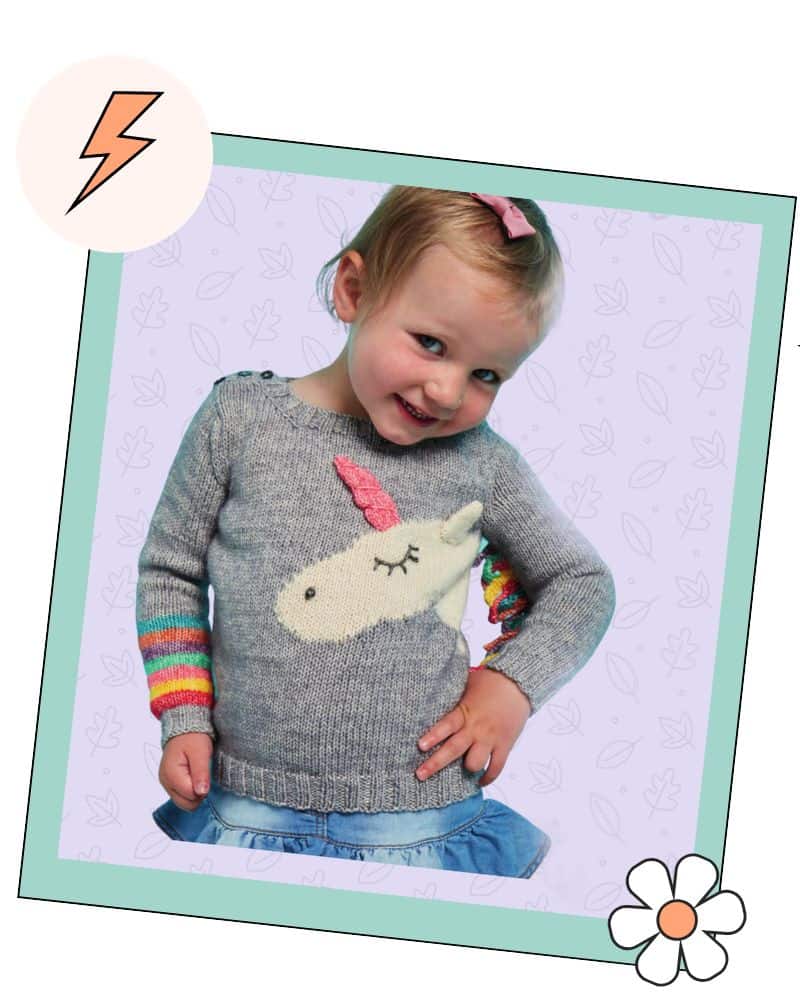
The Unicorn and Rainbows Sweater has a knitted horn, ears, and rainbow fringe details, all constructed separately and attached to the finished garment. The knitting is straightforward. The 3D details are what make it a character piece, and the skills that make those details were inspired by the toys I knit as a new knitter.
A large proportion of my children’s garments use this approach. Small knitted pieces, attached cleanly to a simple base garment. The skills I built working through those toy patterns are the same skills that make a stegosaur spine sit correctly on a hoodie, or a unicorn horn hold its shape on a sweater. You can see more examples in the Stomp Like a Dino Sweater, where the 3D spines are a beginner’s first taste of small-part construction on a garment.
The “It Looks Complicated” Problem
Someone looks at a character children’s jumper with 3D detail and decides it is beyond them. They put it back in favour of something plain.
Almost always, the knitting itself is not the complicated part. The garment body is straightforward. The 3D elements are small and quick to work. The skill gap is usually just unfamiliarity with small-part construction, and that is exactly what Jean Greenhowe knitting patterns and those of Alan Dart patterns build.
If you have knitted a toy, you have already done the hard part. You have knitted small pieces, shaped them, and assembled them into something that holds its form. A knitted stegosaur spine or a unicorn horn is the same skill set, just on a jumper instead of a toy.
If you have not knitted a toy before and fancy trying one first, a simple Jean Greenhowe Christmas character is a genuinely good place to start. Come back to the character garments afterwards. They will look entirely different.
Frequently Asked Questions
Are Jean Greenhowe knitting patterns still available?
Yes. Many of her books and booklets can still be found through second-hand book sellers, eBay, and specialist knitting retailers. She has a devoted following.
Are Jean Greenhowe knitting patterns suitable for beginners?
Most are suitable for confident beginners who are comfortable following a pattern closely. The individual pieces are small and the shaping is straightforward. The main requirement is patience with the assembly stage.
Do you need special yarn for toy knitting?
Not necessarily. Most Jean Greenhowe and Alan Dart patterns use standard DK or 4 ply yarn. If you are unsure which weight to use, the Craft Yarn Council yarn weight standards are a useful reference. The key is a firm tension so the stuffing does not show through, and a yarn with good stitch definition so you can see your shaping clearly.
Can the skills from toy knitting really transfer to garment knitting?
Yes. Shaping, small-part construction, seaming, and 3D assembly are all directly transferable. If you can knit a Jean Greenhowe toy cleanly, the character garments in my children’s collection are well within your reach. The scale is larger, but the principle is the same.
If you have found yourself down a toy knitting rabbit hole and wondering about safety standards for knitted toys, the UK Hand Knitting Association has a useful guide. I have also covered the key safety considerations in my Flopsy Bunny Rattle pattern post.
You might also like:
- Knitting for Babies and How to Get It Right — yarn choices, construction, and what to know before you cast on
- Baby & Children’s Knitting Size Guide — measurements from newborn to 11 years
- Monkey Jumper Knitting Pattern with Colouring Page, Meet Rascal — a character children’s jumper with 3D knitted ears
Happy knitting,
Jane 🧶
About Jane
Jane is a UK based knitting and crochet pattern designer with 18 years of experience, specialising in whimsical, characterful patterns for babies and children. She is the founder of Jane Burns Whimsical Designs, with a focus on patterns that carry real personality, and on making knitting feel accessible, joyful, and a little bit daft when it needs to be.