This gnome knitting chart is inspired by one of the most recognisable figures of Christmas.
Gnomes have taken over Christmas. Not Santa, not a robin, not even a particularly well-placed sprig of holly. A small, bearded fellow in a hat so large he can barely see past the brim, clutching a present roughly his own size. And honestly, who can blame anyone for loving them.
Meet Pip, a free gnome knitting chart for the Blank Canvas Baby Jumper.
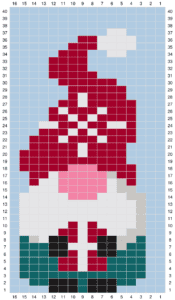
*Scroll down for full size chart and legend
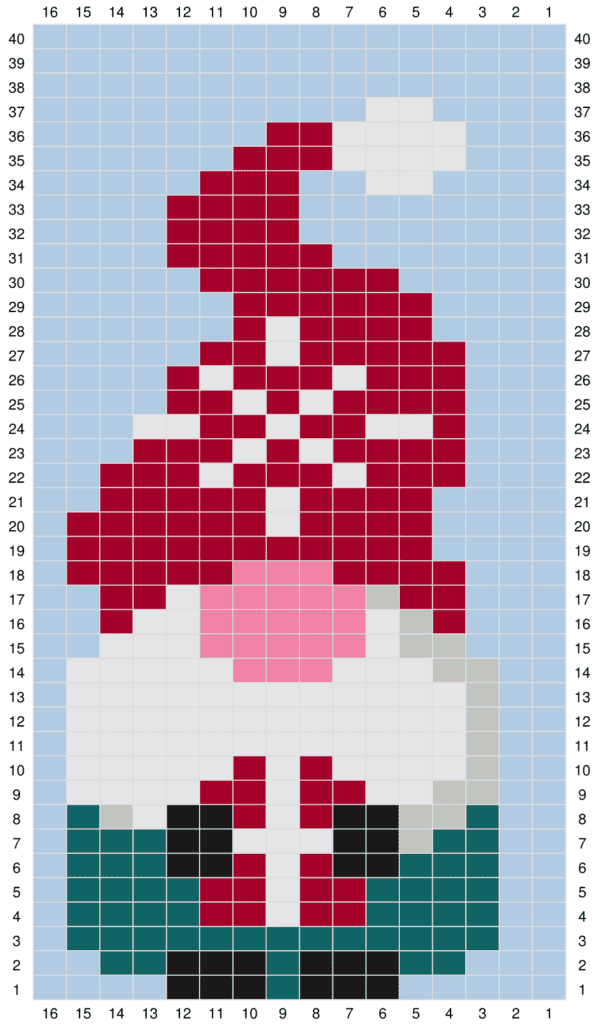
He is 16 stitches wide and 40 rows tall, designed to sit perfectly on the Blank Canvas Baby Sweater across all sizes. His hat is claret, his beard is white, and his present is very important to him. The smaller details, the snowflake, the hands, and the feet, are worked in duplicate stitch once the knitting is done. It is a neat little technique that gives you much more control over tiny areas of colour, and if you have never tried it, this is a lovely place to start.
Best of all, Pip is a stash buster. He needs no more than 10g of any single colour, and while the shades shown here are all Stylecraft Special DK, any DK yarn will do the job beautifully. This is an excellent excuse to dig out every oddment you have been saving and give your gnome an entirely different personality. A teal hat. A pale blue beard. A present in whatever colour your stash insists upon.
QUICK LOOK AT THE SWEATER
| Skill level | Confident Beginner |
| Construction | Worked flat, seamed |
| Techniques used | Stocking stitch, 2×2 rib, intarsia colourwork, duplicate stitch |
| Yarn | Stylecraft Special DK |
| Needles | 3.25mm and 4mm straight; 3.25mm circular (optional, for neckband) |
| Tension | 22 sts x 30 rows = 10cm x 10cm using 4mm needles and stocking stitch |
| Sizes | 0-6 months to 4-5 years (6 sizes) |
| What’s free | Pip the gnome knitting chart and front panel instructions, right here on the blog |
| Full pattern | Free at janeburns.co.uk/free-baby-jumper-knitting-pattern-with-motif |
| Perfect for | Christmas gift knitting, boys and girls, confident beginners and above |
The Chart
About Pip the Christmas Gnome
Pip is a Christmas gnome knitting chart worked in stocking stitch, using the intarsia method for the main colour sections. He is one of the first motifs in the Blank Canvas Motif Library, a growing collection of free charts designed to work with the Blank Canvas Baby Sweater.
The base pattern gives you the full jumper construction, including the back, sleeves, neckband, and finishing instructions. This post gives you the gnome knitting chart, the full written row-by-row instructions, the yarn requirements for the motif colours, and the placement instructions so you know exactly where to position Pip on the front.
The smaller details, Pip’s snowflake, his hands, and his feet, are added in duplicate stitch once the main knitting is complete. This gives you much more control over tiny areas of colour than trying to manage very short lengths of yarn across a row.
Worked in Stylecraft Special DK, this is a practical, washable, easy-care choice for a children’s Christmas jumper. The yarn is widely available, affordable, and comes in exactly the shades you need for a very self-important little gnome with a very large present.
Sizes
This pattern is sized to fit children from 0-6 months up to 4-5 years.
| Size | 0–6m | 6–12m | 12–18m | 18–24m | 2–3y | 4–5y | |
|---|---|---|---|---|---|---|---|
| To fit chest | cm | 41 | 46 | 51 | 53 | 56 | 61 |
| in | 16 | 18 | 20 | 21 | 22 | 24 | |
| Actual chest | cm | 48 | 54 | 59 | 61 | 63 | 68 |
| in | 19 | 21.75 | 23.25 | 24 | 24.75 | 26.75 | |
| Finished length | cm | 27 | 29 | 32 | 35 | 37 | 39 |
| in | 10.5 | 11.5 | 12.5 | 13.75 | 14.5 | 15.25 | |
| Sleeve length | cm | 16 | 18 | 26 | 30 | 32 | 36 |
| in | 6.5 | 7 | 10.5 | 12 | 12.5 | 14.25 |
Materials
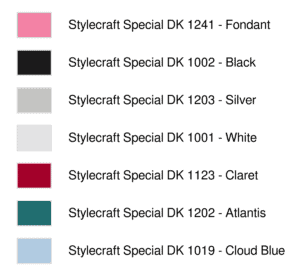
Yarn: Stylecraft Special DK (100% acrylic, 295m per 100g ball)
| Yarn | 0–6m | 6–12m | 12–18m | 18–24m | 2–3y | 4–5y | |
|---|---|---|---|---|---|---|---|
| Yarn A | Cloud Blue (1019) | 1 | 1 | 2 | 2 | 2 | 3 |
| Small amounts only — great stash busters | |||||||
| Claret | Stylecraft Special DK (1123) — hat and body | ||||||
| White | Stylecraft Special DK (1001) — beard and hat trim | ||||||
| Fondant | Stylecraft Special DK (1241) — nose | ||||||
| Atlantis | Stylecraft Special DK (1202) — legs | ||||||
| Black | Stylecraft Special DK (1002) — boots and eyes | ||||||
| Silver | Stylecraft Special DK (1203) — beard detail | ||||||
Small amounts only for motif colours, no more than 10g of any single shade. Great stash busters.
If you do not have the stash buster shades to hand, a single ball of each will give you far more than you need and leave you with plenty for future projects.
If you have Yarnsmiths Create DK or Cascade 220 Superwash in your stash and want to find the nearest shade match to the Stylecraft colours listed, the yarn substitution chart lets you search any shade name or number and find the closest equivalent across all three ranges instantly.
Needles:
Straight 3.25mm and 4mm.
Circular 3.25mm useful for the neckband, but straight needles will work.
Also needed:
Darning needle
Stitch markers
Stitch holder
Tension:
22 sts x 30 rows = 10cm x 10cm using 4mm needles and stocking stitch. To save time, take time to check your tension.
Abbreviations
This pattern uses standard UK knitting abbreviations. You can download the free Knitting Abbreviations Guide from the shop here: Knitting Abbreviations Guide
How to work the gnome knitting chart
Pip is worked using the intarsia technique. This means each section of colour uses a separate small ball or bobbin of yarn, with no yarn carried across the back of the work.
If you have not tried intarsia before, it is more manageable than it looks. Very Pink Knits has a clear video guide to intarsia that is well worth watching before you cast on.
How to read the chart: Start at the bottom right-hand corner. Read right-side rows from right to left. Read wrong-side rows from left to right. Each square represents one stitch. Each row of squares represents one row of knitting.
A note on duplicate stitch: The snowflake on Pip’s present, his hands, and his feet are small enough that carrying a separate length of yarn for each one would create more trouble than it is worth. Work these details in duplicate stitch once the knitting is complete instead. Duplicate stitch, also known as Swiss darning, sits on top of the knitted fabric and mimics the look of a knitted stitch perfectly. Very Pink Knits has a helpful video guide to duplicate stitch if you have not tried it before.
The Base Pattern
This gnome knitting chart is designed to be used with the Blank Canvas Baby Sweater. You will need the base pattern for the back, sleeves, neckband, and finishing instructions. The Blank Canvas Baby Sweater is free on the blog and available as a PDF in the shop.
Working the Front including the Gnome Knitting Chart
You will find full instructions for the sweater, including Back, Sleeves, Neckband and making up in the Blank Canvas Baby Sweater here
Front
Cast on 52 (56: 64: 68: 72: 76) sts using 3.25mm needles and Yarn A.
Row 1: *K2, p2; rep from * to end.
Repeat row 1 a further 7 (7: 9: 11: 13: 13) times.
Change to 4mm needles
Row 1: Knit.
Row 2: Purl.
Start working from Chart
Row 1: K18 (20: 24: 26: 28: 30) using Yarn A, work row one from Chart, knit to end using Yarn A.
Row 2: P18 (20: 24: 26: 28: 30) using Yarn A, work row two from Chart, purl to end using Yarn A.
Continue working Chart as set to end. AT THE SAME TIME WHEN PIECE MEASURES 16 (18: 19.5: 20: 20: 21.5) cm from cast-on edge, place markers at beg and end of row to mark sleeve placement.
Next: Continue in stocking stitch until piece measures 27 (29: 32: 35: 37: 39)cm from cast-on edge, ending with a RS row.
Shape shoulders:
Next row: P15 (17: 19: 20: 22: 24), PM, p22 (22: 26: 28: 28: 28), PM, p15 (17: 19: 20: 22: 24).
Cast off, keeping markers in place.
The chart
Written Line by Line Chart
If you prefer to work from written instructions rather than from a chart you can work line by line from the instructions below. You will need to remember to work the stitches either side of the chart according to the size you have chosen.
For example:
Row 1: K18 (20: 24: 26: 28: 30) using Yarn A, work row one from Written Chart Instructions, knit to end using Yarn A.
Row 2: P18 (20: 24: 26: 28: 30) using Yarn A, work row two from Written Chart Instructions, purl to end using Yarn A.
Row 1: Cloud Blue x5, Black x3, Atlantis x1, Black x3, Cloud Blue x4
Row 2: Cloud Blue x3, Atlantis x2, Black x3, Atlantis x1, Black x3, Atlantis x2, Cloud Blue x2
Row 3: Cloud Blue x2, Atlantis x13, Cloud Blue x1
Row 4: Cloud Blue x2, Atlantis x4, Claret x2, White x1, Claret x2, Atlantis x4, Cloud Blue x1
Row 5: Cloud Blue x2, Atlantis x4, Claret x2, White x1, Claret x2, Atlantis x4, Cloud Blue x1
Row 6: Cloud Blue x2, Atlantis x3, Black x2, Claret x1, White x1, Claret x1, Black x2, Atlantis x3, Cloud Blue x1
Row 7: Cloud Blue x2, Atlantis x2, Silver x1, Black x2, White x3, Black x2, Atlantis x3, Cloud Blue x1
Row 8: Cloud Blue x2, Atlantis x1, Silver x2, Black x2, Claret x1, White x1, Claret x1, Black x2, White x1, Silver x1, Atlantis x1, Cloud Blue x1
Row 9: Cloud Blue x2, Silver x2, White x2, Claret x2, White x1, Claret x2, White x4, Cloud Blue x1
Row 10: Cloud Blue x2, Silver x1, White x4, Claret x1, White x1, Claret x1, White x5, Cloud Blue x1
Row 11: Cloud Blue x2, Silver x1, White x12, Cloud Blue x1
Row 12: Cloud Blue x2, Silver x1, White x12, Cloud Blue x1
Row 13: Cloud Blue x2, Silver x1, White x12, Cloud Blue x1
Row 14: Cloud Blue x2, Silver x2, White x3, Fondant x3, White x5, Cloud Blue x1
Row 15: Cloud Blue x3, Silver x2, White x1, Fondant x5, White x3, Cloud Blue x2
Row 16: Cloud Blue x3, Claret x1, Silver x1, White x1, Fondant x5, White x2, Claret x1, Cloud Blue x2
Row 17: Cloud Blue x3, Claret x2, Silver x1, Fondant x5, White x1, Claret x2, Cloud Blue x2
Row 18: Cloud Blue x3, Claret x4, Fondant x3, Claret x5, Cloud Blue x1
Row 19: Cloud Blue x4, Claret x11, Cloud Blue x1
Row 20: Cloud Blue x4, Claret x4, White x1, Claret x6, Cloud Blue x1
Row 21: Cloud Blue x4, Claret x4, White x1, Claret x5, Cloud Blue x2
Row 22: Cloud Blue x3, Claret x3, White x1, Claret x3, White x1, Claret x3, Cloud Blue x2
Row 23: Cloud Blue x3, Claret x4, White x1, Claret x1, White x1, Claret x3, Cloud Blue x3
Row 24: Cloud Blue x3, Claret x1, White x2, Claret x2, White x1, Claret x2, White x2, Cloud Blue x3
Row 25: Cloud Blue x3, Claret x4, White x1, Claret x1, White x1, Claret x2, Cloud Blue x4
Row 26: Cloud Blue x3, Claret x3, White x1, Claret x3, White x1, Claret x1, Cloud Blue x4
Row 27: Cloud Blue x3, Claret x5, White x1, Claret x2, Cloud Blue x5
Row 28: Cloud Blue x4, Claret x4, White x1, Claret x1, Cloud Blue x6
Row 29: Cloud Blue x4, Claret x6, Cloud Blue x6
Row 30: Cloud Blue x5, Claret x6, Cloud Blue x5
Row 31: Cloud Blue x7, Claret x5, Cloud Blue x4
Row 32: Cloud Blue x8, Claret x4, Cloud Blue x4
Row 33: Cloud Blue x8, Claret x4, Cloud Blue x4
Row 34: Cloud Blue x4, White x2, Cloud Blue x2, Claret x3, Cloud Blue x5
Row 35: Cloud Blue x3, White x4, Claret x3, Cloud Blue x6
Row 36: Cloud Blue x3, White x4, Claret x2, Cloud Blue x7
Row 37: Cloud Blue x4, White x2, Cloud Blue x10
Row 38: Cloud Blue x16
Row 39: Cloud Blue x16
Row 40: Cloud Blue x16
The Pip Gnome chart is free to use right here on the blog, but if you would like a copy to save, print, and keep at your knitting bag, the premium PDF is available in the shop. It includes the full colour chart, the complete written row-by-row instructions, and the placement notes for all six sizes of the Blank Canvas Baby Sweater, so everything you need is in one tidy document rather than spread across a screen. Particularly useful if you are a print-and-annotate knitter, or if you would simply rather not have your phone propped up against the yarn bowl for the duration. Pick up the Pip Gnome PDF in the shop here.
Mix it up: Variations
Play with Pip’s colours
The shades listed are a starting point, not a rule. Pip is very open to a wardrobe change. A forest green hat, a navy coat, a beard in any shade of cream your stash happens to contain. The only suggestion is to keep the nose in a contrast pink or peach tone so his little face reads clearly, but beyond that, dig in and see what your oddment collection comes up with. No two Pips need to look the same.
Add stripes to the sleeves
The Blank Canvas Baby Sweater sleeve instructions include a stripe sequence worked in two contrast colours, and it works beautifully with Pip too. Pick up the claret from his hat for a coordinated look, or go in a completely different direction and let the sleeves surprise everyone. Full sleeve instructions, including the stripe sequence, are in the Blank Canvas Baby Sweater base pattern.
Use duplicate stitch for all the small details
The snowflake, hands, and feet are already recommended as duplicate stitch. If you prefer to keep things simple, you can also work any other single-stitch colour changes in duplicate stitch after the knitting is complete. It gives the same result with a little less juggling on the needles.
Knit the whole trio
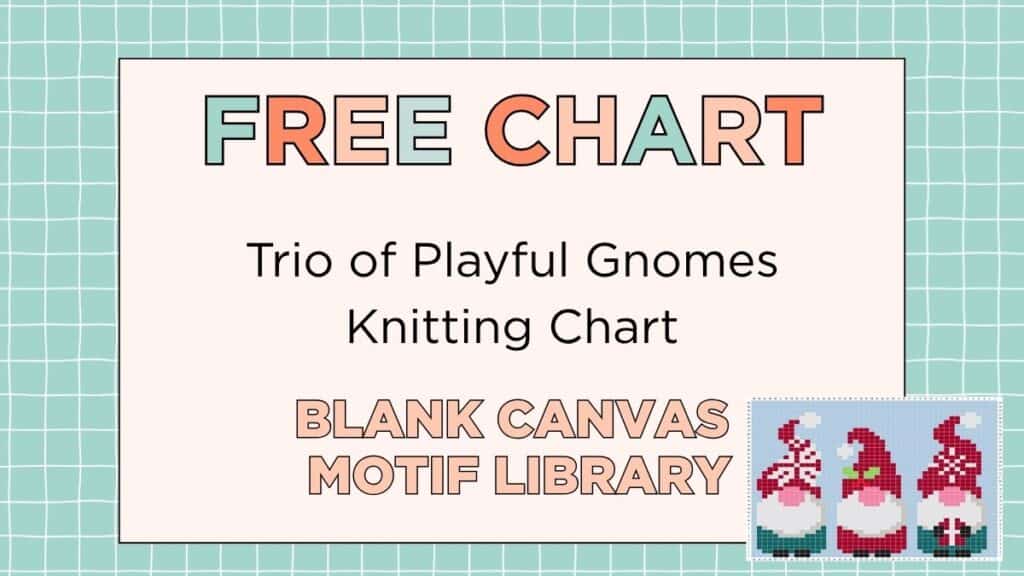
Pip will not be the only gnome in the Blank Canvas Motif Library for long. Once all three are live, knitting a different gnome onto each size of the sweater for the children in your life is a very satisfying way to work through your Christmas list. Keep an eye on the Blank Canvas Motif Library for new arrivals.
Personalise it with a name
Embroidering a child’s name above the motif in a contrast colour turns a lovely Christmas jumper into something with their name on it, which is a different thing entirely. Swiss darning works well for this. There are plenty of free alphabet charts available online to use as a guide.
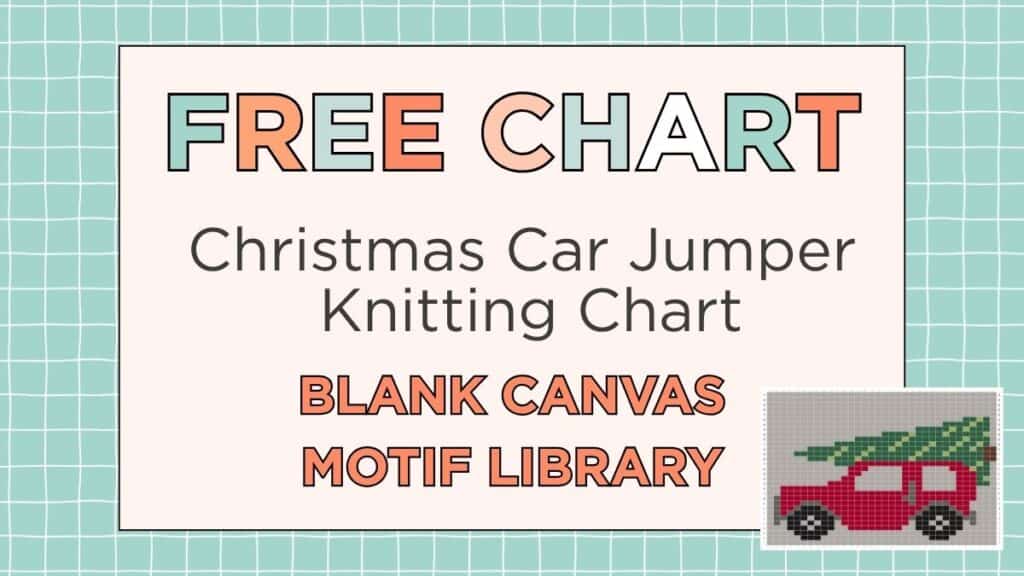
If you are looking for another festive motif to get started with, the Little Red Christmas Car is already in the library and makes a lovely companion piece to Pip.
More Christmas Knitting Patterns for Children
If you are planning your Christmas gift knitting, you might also enjoy the full collection of Christmas patterns in the shop. There are over 44 designs for babies and children, from classic snowmen and robins to character jumpers, hooded blankets, and accessories. Browse the full Christmas collection here.
Frequently Asked Questions
What is duplicate stitch and when should I use it?
Duplicate stitch, also known as Swiss darning, is an embroidery technique worked on top of completed knitting. It mimics the appearance of a knitted stitch and is ideal for very small areas of colour, such as a single stitch or a two stitch detail, where carrying a separate length of yarn would create an untidy result. For Pip, the snowflake, hands, and feet are all worked this way after the main knitting is complete.
Can I use a different yarn for this gnome knitting chart?
Yes. Any DK weight yarn will work with this chart. The shades listed are Stylecraft Special DK, which is widely available, machine washable, and excellent value, but the colours shown are a starting point rather than a requirement. Pip is very open to a wardrobe change.
What size jumper does this gnome knitting chart fit?
Pip is designed to work across all six sizes of the Blank Canvas Baby Sweater, from 0-6 months up to 4-5 years. The chart sits centrally on the front panel at every size, and the placement instructions above tell you exactly where to position him for each size.
Can I use this gnome knitting chart on other baby knitting patterns?
Pip works on any stocking stitch baby jumper with a front panel wide enough to accommodate 16 stitches. He is designed for the Blank Canvas Baby Sweater but there is nothing to stop a confident knitter from placing him on a plain stocking stitch panel of another pattern.
How do I get the Blank Canvas Baby Sweater pattern?
The Blank Canvas Baby Sweater is a free pattern available on the blog. You will find the full pattern, including all sizes and front panel guidance, right here. Blank Canvas Baby Sweater
Is this gnome knitting chart suitable for a beginner?
The stocking stitch construction is straightforward and the chart is clearly written. The intarsia sections add a small amount of complexity, but Pip uses manageable colour sections and is a good confident beginner project. The duplicate stitch details are worked after the knitting is complete and are a straightforward technique to pick up. If you are new to intarsia, the Very Pink Knits video guide is a good place to start.
Pip is one of the first gnomes to take up residence in the Blank Canvas Motif Library. He will not be alone for long. If you would like to see what else is available, including more free charts for the Blank Canvas Baby Sweater, you can find them all here.
Never Miss a New Motif
New charts are added to the Blank Canvas Motif Library regularly throughout the year. Sign up to the Jane Burns newsletter and I will let you know the moment a new one lands, along with free patterns, tips, and the occasional dry observation about the knitting life.
About Jane
I’ve been creating knitting and crochet patterns for 18 years, designing characterful pieces for babies and children that are as fun to knit as they are to wear. You can find all of my patterns at shop.janeburns.co.uk, follow along on Instagram and Facebook, or pin your favourites over on Pinterest.
This pattern is for personal use only. Finished items may be sold in small quantities with credit given to Jane Burns for the design. Pattern designed by Jane Burns, with 18 years of experience creating exclusive knitting and crochet patterns for babies and children.