
Knitting Abbreviations Guide: What They All Mean
You’ve found a pattern you love. You’ve got the yarn. You’re ready to go. Then you open page one and it says something like sl1, k1, psso, yfwd, rep from * to last 3 sts, k2tog, k1 and suddenly you feel like you’ve accidentally enrolled in a GCSE in a language you’ve never heard of. This knitting abbreviations guide is here to translate.
Don’t panic. Knitting abbreviations are not a secret code designed to exclude beginners, they’re just shorthand, invented so that a pattern row doesn’t take three paragraphs to write out. Once you know them, they become second nature. This knitting abbreviations guide covers everything you’re likely to encounter, grouped by type so you can find what you need quickly. For reference, the industry standard knitting abbreviations list is maintained by the Craft Yarn Council worth bookmarking alongside this page.
Bookmark this page. You’ll come back to it more than once.
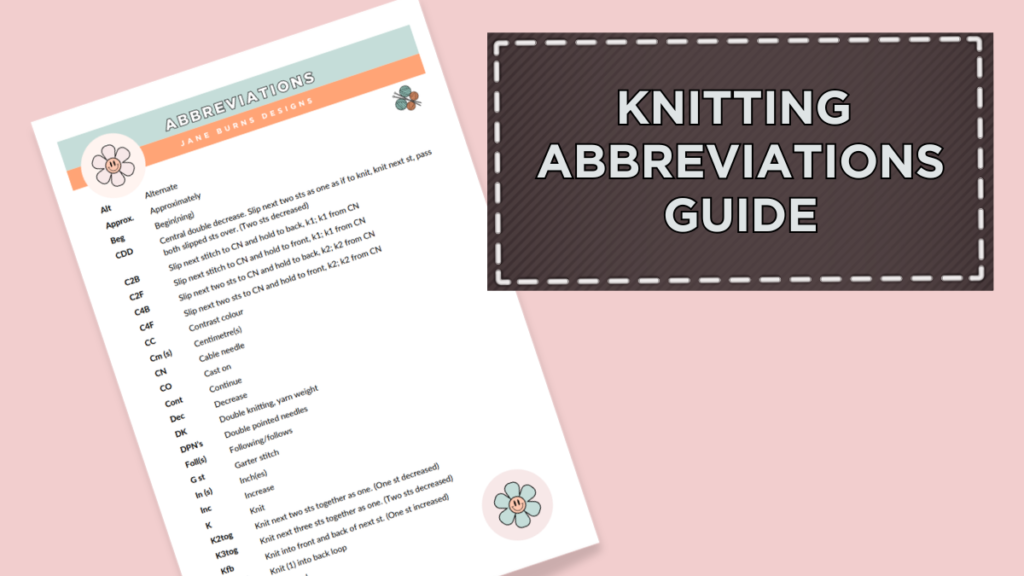
Table of Contents
Note: This guide covers knitting abbreviations only. A crochet abbreviations guide is coming soon!
Basic Knitting Abbreviations
These are the ones that appear in almost every pattern you’ll ever pick up. If you learn nothing else, learn these.
| Abbr. | Meaning | Notes |
|---|---|---|
| k | Knit | The fundamental stitch. You know this one. |
| p | Purl | The other fundamental stitch. You know this one too. |
| st | Stitch | Singular. One loop on your needle. |
| sts | Stitches | Plural. More than one loop on your needle. |
| RS | Right side | The public-facing side of your work — the side the world sees. |
| WS | Wrong side | The inside of your work. Not wrong, just private. |
| beg | Beginning | Start of the row or round. |
| end | End | End of the row or round. |
| rem | Remaining | The stitches left after you’ve done the thing. |
| rep | Repeat | Do the thing again. Usually appears with an asterisk (see below). |
| cont | Continue | Carry on as you were. |
| alt | Alternate | Every other row or stitch. |
| approx | Approximately | Not exact. Knitting is an approximate art. |
| patt | Pattern | Work in the established pattern stitch. |
| tbl | Through back loop | Insert needle through the back of the stitch instead of the front. |
| tog | Together | Work two or more stitches as one. Usually seen as k2tog or p2tog. |
| foll | Following | The next row, round, or instruction after this one. |
| inc | Increase | Add a stitch. Your stitch count goes up. |
| dec | Decrease | Remove a stitch. Your stitch count goes down. |
| rnd / rds | Round / Rounds | Used when knitting in the round rather than flat rows. |
| [ ] | Square brackets | Work the instructions inside a set number of times, e.g. [k2, p2] 3 times. |
| * | Asterisk | Marks the start of a section to be repeated. “Rep from * to end” means do it again until you run out of stitches. |
| ** | Double asterisk | A second repeat marker when the pattern has nested repeats. Slightly more chaotic. Breathe. |
Shaping Abbreviations
Shaping is where you increase and decrease stitches to create the actual shape of a knitted piece or garment. This is also where many knitters first encounter an abbreviation and stare at it blankly for longer than they’d like to admit. You are not alone. Here’s what they all mean.
| Abbr. | Meaning | Notes |
|---|---|---|
| k2tog | Knit two together | A right-leaning decrease. Insert needle through two stitches at once and knit them as one. |
| p2tog | Purl two together | Same idea, on a purl row. Also right-leaning. |
| ssk | Slip, slip, knit | A left-leaning decrease. Slip two stitches knitwise, return to left needle, knit through back loops. |
| skpo | Slip one, knit one, pass slipped stitch over | Another left-leaning decrease. Older UK patterns often use this instead of ssk. |
| sl1, k1, psso | Slip one, knit one, pass slipped stitch over | Exactly the same as skpo, just written out the long way. Same decrease, different notation. |
| k3tog | Knit three together | A double decrease — removes two stitches at once. Appears in lace patterns and pointy hat tips. |
| s2kpo | Slip two, knit one, pass slipped stitches over | A centred double decrease. Used in lace to create a neat vertical line at the decrease. |
| m1 | Make one | An increase. Lift the bar between stitches and knit into it. Direction unspecified — check your pattern. |
| m1l | Make one left | Lift the bar from front to back, knit through the back loop. Leans left. |
| m1r | Make one right | Lift the bar from back to front, knit through the front loop. Leans right. |
| m1p | Make one purlwise | As m1, but purled. Used on WS rows or in rib shaping. |
| yo | Yarn over | Wrap the yarn over the needle to create a new stitch (and usually a hole). The backbone of lace knitting. |
| yfwd | Yarn forward | UK term. Bring yarn to front between needles before knitting the next stitch. Creates a yarn over. |
| yon | Yarn over needle | UK term. Wrap yarn over needle — usually between a knit and a purl stitch. |
| yrn | Yarn round needle | UK term. Wrap yarn around needle — usually between two purl stitches. |
| kfb | Knit into front and back | An increase. Knit into the front of the stitch, then the back before sliding it off. Creates two stitches from one. |
| pfb | Purl into front and back | Same concept, purled. Less common but it exists. |
| w&t | Wrap and turn | Used in short row shaping. Wraps the next stitch to prevent a hole, then turns the work mid-row. |
Needle, Yarn & Tension Abbreviations
These appear in the pattern header, the bit before you start knitting and in any instructions involving needle changes, yarn management, or tension squares that you’re definitely going to swatch properly this time.
| Abbr. | Meaning | Notes |
|---|---|---|
| mm | Millimetres | Needle size. UK patterns use metric. If your pattern says “size 6”, it’s probably American (see UK vs US section). |
| cn | Cable needle | The small extra needle used to hold stitches when working cables. Easily lost. Always keep a spare. |
| dpn | Double-pointed needle(s) | Short needles with points at both ends, used for knitting small circumferences in the round (socks, sleeves, the top of a hat). |
| circ | Circular needle | Two needle tips joined by a cable. Can be used flat or in the round. |
| LH | Left-hand needle | The needle in your left hand. Stitches live here before you knit them. |
| RH | Right-hand needle | The needle in your right hand. Stitches move here after you knit them. |
| MC | Main colour | The primary yarn colour in a stranded or Fair Isle pattern. |
| CC | Contrast colour | The secondary yarn colour. Some patterns have CC1, CC2, CC3 and so on, at which point a sticky note is advisable. |
| wyif | With yarn in front | Hold the yarn at the front of the work (towards you) before making the next move. |
| wyib | With yarn in back | Hold the yarn at the back of the work (away from you) before making the next move. |
| yf | Yarn forward | Bring yarn to front of work. Used in slip stitch patterns and some lace. |
| yb | Yarn back | Take yarn to back of work. |
| tension | Tension | UK term for the number of stitches and rows per 10 cm. The thing the pattern tells you to check and which you absolutely should check. No, really. |
Slip Stitch Abbreviations
Slip stitches come up constantly, in decreases, in colourwork, in heel turns, in selvedges. The key detail is always how you slip the stitch, because it affects which way the stitch sits on the needle and therefore how the finished fabric looks.
| Abbr. | Meaning | Notes |
|---|---|---|
| sl | Slip | Move a stitch from left needle to right needle without knitting it. |
| sl1k / sl1 kwise | Slip one knitwise | Insert needle as if to knit, then slip. Twists the stitch. Used in most decreases. |
| sl1p / sl1 pwise | Slip one purlwise | Insert needle as if to purl, then slip. Keeps the stitch untwisted. The default slip stitch unless otherwise stated. |
| psso | Pass slipped stitch over | Lift the slipped stitch over the stitch just worked and off the needle. Part of skpo and sl1, k1, psso decreases. |
| p2sso | Pass two slipped stitches over | As above, but lift two slipped stitches over. Used in double decreases. |
Cable Abbreviations
Cable patterns have their own abbreviation system which can look alarming at first glance. Once you understand the logic, it’s quite elegant. The number tells you how many stitches are involved; the letter tells you which way the cable twists.
| Abbr. | Meaning | Notes |
|---|---|---|
| c4f | Cable 4 front | Slip 2 sts to cable needle and hold at front, k2, then k2 from cable needle. Creates a left-twisting cable. |
| c4b | Cable 4 back | Slip 2 sts to cable needle and hold at back, k2, then k2 from cable needle. Creates a right-twisting cable. |
| c6f | Cable 6 front | As c4f but with 3 stitches each side. The number always refers to the total stitches in the cable. |
| c6b | Cable 6 back | As c4b but with 3 stitches each side. |
| t3f | Twist 3 front | A travelling stitch — moves a knit stitch across a purl background towards the left. |
| t3b | Twist 3 back | As above but travelling right. |
| cr2l | Cross 2 left | A mini cable — crosses 2 stitches to the left without a cable needle. Quick once you get the hang of it. |
| cr2r | Cross 2 right | As above, crossing to the right. |
Note: Cable abbreviations are not fully standardised across publishers. Always check your specific pattern’s abbreviation key — some designers write C4F to mean something slightly different from others. The key is usually at the front or back of the pattern. If in doubt, read the written instructions rather than relying on the abbreviation alone.
Finishing & Construction Abbreviations
These appear at the end of a pattern section, or in construction methods like working in the round or joining pieces together.
| Abbr. | Meaning | Notes |
|---|---|---|
| CO | Cast on | Create the initial row of stitches on your needle. There are many methods — your pattern may specify one. |
| cast off | Cast off | UK term. Secure the final stitches so they don’t unravel. Also called bind off in US patterns. |
| pm | Place marker | Slip a stitch marker onto your needle at this point. Useful for marking pattern repeats, increases, or section boundaries. |
| sm | Slip marker | Move the marker from left to right needle without knitting it. Just slide it along. |
| rm | Remove marker | Take the marker off entirely. |
| BOR | Beginning of round | The marker that tells you where each new round starts when knitting in the round. |
| PUK | Pick up and knit | Insert needle into the edge of the fabric and draw through a loop of yarn to create a new stitch. Used for neckbands, button bands, and sleeve cuffs. |
| 3-needle CO | Three-needle cast off | A method of casting off two sets of live stitches simultaneously to join two pieces. Neat and tidy. |
| Kitchener | Kitchener stitch / grafting | A grafting method that joins live stitches invisibly. The technical name for the thing you do to toe-up sock toes. More satisfying than it sounds. |
| seam | Seam | Join two pieces of knitted fabric together. Various methods exist — mattress stitch is the most common for side seams. |
| block | Block | Wet or steam the finished piece to even out the stitches and set the shape. Highly recommended. Transformative. |
Pattern Instruction Notation
These aren’t abbreviations as such, they’re the punctuation and shorthand conventions that tell you how to read the instructions themselves. Once you understand these, a dense pattern row becomes much less intimidating.
| Abbr. | Meaning | Notes |
|---|---|---|
| * … rep from * | Repeat from asterisk | Work the instructions between the asterisk and the comma once, then repeat that section to the end of the row. |
| * … to last X sts | Repeat to last stitches | Work the repeat, then stop when X stitches remain. The instructions will tell you what to do with those last stitches. |
| [ ] X times | Brackets repeat | Work the instructions in brackets the stated number of times, e.g. [k2, p2] 4 times. |
| work even | Work even / work straight | Continue without increasing or decreasing. “Work straight for 5 cm” means just keep knitting. |
| AT THE SAME TIME | Two things simultaneously | Usually written in capitals because it really matters. You need to work two sets of instructions at once — typically shaping at two edges or a neckline and armhole together. |
| as set | As set | Work the stitches as they present — knit the knits, purl the purls, continue the cable pattern, etc. |
| keeping patt correct | Maintain pattern | Decrease at the edges while keeping the pattern (rib, cable, lace) lining up properly in the middle. Requires a small amount of mental gymnastics. |
| place on hold | Place on hold / waste yarn | Set these stitches aside without casting them off. Transfer to a stitch holder or scrap yarn — you’ll come back to them. |
| sizes X (X, X) | Multiple sizes | Instructions are given for the smallest size, with larger sizes in brackets. Mark your size before you start so you don’t lose track mid-pattern. Trust me on this one. |
UK vs US Knitting Terms
If you’ve ever picked up an American knitting pattern and felt like something was subtly wrong, there’s a good reason for that. UK and US knitting abbreviations share a vocabulary but don’t always agree on what the words mean. The stitches are identical, just the names have drifted. Here are the main knitting abbreviations differences to watch out for.
Technique & Method Terms
| UK Term | US Term | Notes |
|---|---|---|
| Cast off | Bind off | Same action, different name. UK knitters cast off; US knitters bind off. Neither is wrong, they just grew up differently. |
| Tension | Gauge | The number of stitches and rows per 10 cm (or 4 inches in US patterns). The word changes; the importance of checking it does not. |
| Moss stitch | Seed stitch | UK moss stitch alternates k1, p1 and staggers on each row. US seed stitch is the same thing. (US moss stitch is a different texture — rows of k1, p1 aligned rather than staggered.) |
| Double moss stitch | Moss stitch | This is where it gets confusing. UK double moss = US moss. Best to look at a photo of the stitch if you’re not sure. |
| Stocking stitch | Stockinette stitch | The classic smooth fabric: knit on RS, purl on WS. Same stitch, different spelling of the hat it came from. |
| Reverse stocking stitch | Reverse stockinette | Purl on RS, knit on WS. Used for textural contrast or as the background behind cables. |
| Tension square | Gauge swatch | The small sample you knit before starting a project to check your stitch size matches the pattern. Please do this. Especially for anything with sleeves. |
Yarn Forward Abbreviations
This is the area where UK and US patterns diverge most noticeably in actual row-by-row instructions. US patterns tend to use yo (yarn over) as a catch-all. UK patterns are more specific about exactly what the yarn is doing and where it needs to end up, which is actually more precise, if slightly more to remember.
| UK Term | Abbr. | US Equivalent | When it appears |
|---|---|---|---|
| Yarn forward | yfwd | yo | Between two knit stitches. Bring yarn to front, knit next stitch — yarn goes over needle creating a stitch and a hole. |
| Yarn over needle | yon | yo | Between a purl stitch and a knit stitch. Yarn is already at front; take it over the needle to the back. |
| Yarn round needle | yrn | yo | Between two purl stitches, or between a knit and a purl. Yarn travels all the way round the needle. |
All three UK terms create the same result, a new stitch with a decorative hole. But they specify exactly where the yarn starts and ends up. If you’re translating a US pattern, yo always means one of these three depending on context. Most experienced UK knitters use yfwd, yon, and yrn correctly by feel once they understand what the yarn is doing.
Needle Sizes
UK needle sizes used to be numbered on a system that ran in reverse, a size 8 needle was thinner than a size 6. This system has largely been replaced by metric (millimetres) in modern UK patterns, which is much more sensible. US patterns still use their own numerical system. If you’re using needles labelled with US sizes, here’s a quick reference:
| Metric (mm) | US Size | Old UK Size |
|---|---|---|
| 2.00 mm | 0 | 14 |
| 2.25 mm | 1 | 13 |
| 2.75 mm | 2 | 12 |
| 3.00 mm | — | 11 |
| 3.25 mm | 3 | 10 |
| 3.75 mm | 5 | 9 |
| 4.00 mm | 6 | 8 |
| 4.50 mm | 7 | 7 |
| 5.00 mm | 8 | 6 |
| 5.50 mm | 9 | 5 |
| 6.00 mm | 10 | 4 |
| 6.50 mm | 10.5 | 3 |
| 7.00 mm | — | 2 |
| 8.00 mm | 11 | 0 |
| 9.00 mm | 13 | 00 |
| 10.00 mm | 15 | 000 |
A full needle size conversion chart , covering knitting and crochet hooks — is coming soon.
Tips for Reading a Knitting Pattern
Read the whole pattern before you cast on
This advice appears in every knitting book ever written, and is ignored by approximately everyone at least once. The reason it matters, patterns sometimes include instructions that need to happen simultaneously (see AT THE SAME TIME above), or refer back to something several pages earlier. A quick read-through saves a lot of confused mid-project unravelling.
Mark your size at the start
If you’re working from a multi-size pattern, go through and circle or highlight the numbers for your size before you begin. Switching sizes mid-row because you lost track is a rite of passage, but it doesn’t have to be yours.
Always check the abbreviation key
Cable abbreviations in particular vary between publishers and designers. A pattern’s abbreviation key is the definitive reference for that pattern, always check it rather than assuming you know what c4f means for this specific designer.
When something seems wrong, count your stitches
If a row doesn’t add up or there are too few stitches at the end, count back. Most pattern errors reveal themselves quickly when you work through the maths. And yes, published patterns do occasionally contain errors, even from reputable publishers. Check the designer’s website or Ravelry page for errata if something consistently doesn’t work out.
A lifeline is not an admission of defeat
Threading a length of smooth waste yarn through your live stitches at a point you’re happy with gives you a safety net to return to if something goes wrong further on. Use them freely. Even very experienced knitters use them on complex lace. Wisdom, not weakness.
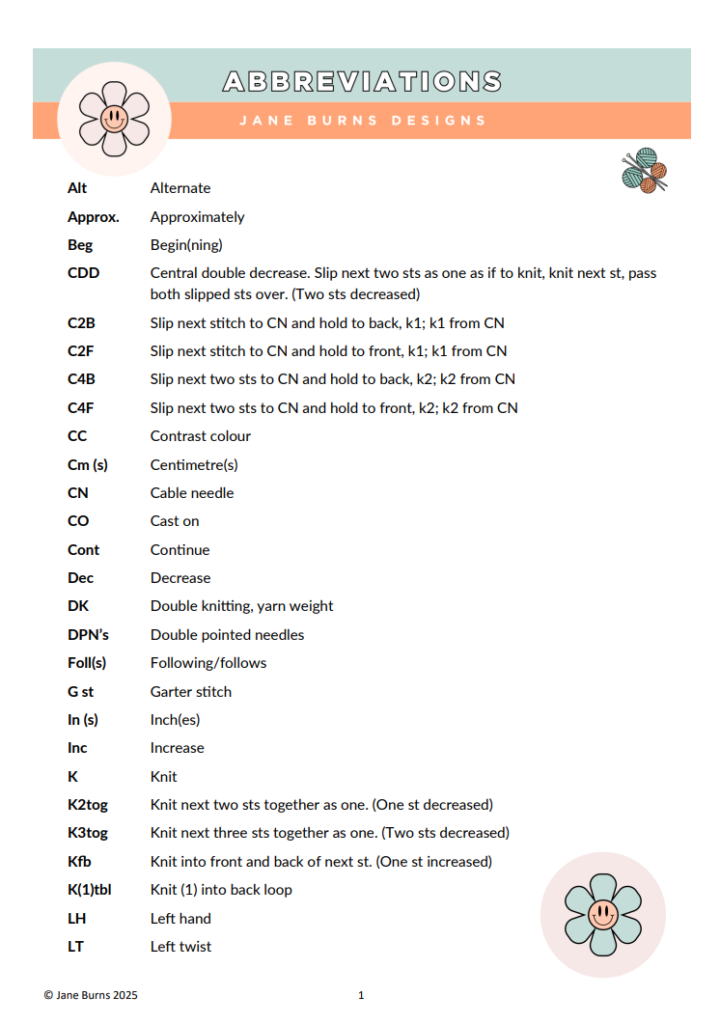
You download my free 3 page, Knitting Abbreviations Guide, your essential reference for all Jane Burns Patterns here: https://shop.janeburns.co.uk/products/free-knitting-abbreviations-guide-essential-reference-for-all-jane-burns-patterns
Are UK and US Knitting Terms the Same?
UK and US knitting abbreviations share a vocabulary but don’t always agree on what the words mean. The stitches are identical, just the names have drifted. Here are the main knitting abbreviations differences to watch out for. https://janeburns.co.uk/knitting-abbreviations-guide/
Related Posts You Might Find Useful
- Baby & Children’s Knitting Size Guide: Measurements by Age — chest, sleeve, head circumference and foot length charts from the Craft Yarn Council.
- Knitting for Babies and How to Get It Right — yarn choices, safety considerations, and construction tips.
- Needle & Hook Size Conversion Chart — coming soon!
- Crochet Abbreviations Guide — coming soon!
A great reputable resource for knitting abbreviations is The Yarn Craft Council, check them out.
If you’ve spotted an abbreviation in a pattern that isn’t on this list, drop me a message, I’m always happy to help decode it.
Happy knitting! 🧶
Jane x