If you’ve ever picked up a crochet pattern and felt like you’re reading a text message from someone who really hates vowels, you are not alone. Crochet abbreviations UK patterns use can look less like instructions and more like the output of a keyboard malfunction, especially when you’re new to the craft.
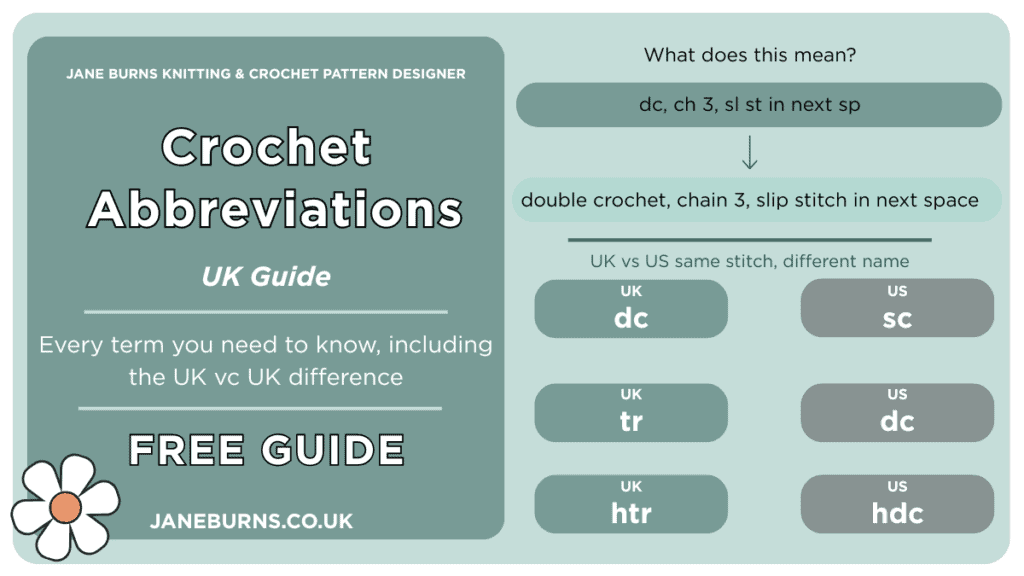
Table of Contents
Because “dc, ch 3, sl st” is not a typo, it’s a perfectly normal thing to say
The good news? Once you know what the abbreviations mean, patterns start to make a lot more sense. The slightly less good news? There are two different sets of crochet terminology in common use, UK and US. And they use the same words to mean completely different things. Which is a choice someone made, apparently.
This guide to crochet abbreviations UK patterns use most often will walk you through what they all mean, and flag the key differences between UK and US terminology so you can navigate any pattern with confidence, regardless of which side of the Atlantic it was written on.
Why Crochet Abbreviations Can Feel Like a Foreign Language (And Why That’s Not Your Fault)
Here’s something nobody tells you when you pick up your first hook, there is no single, universal standard for how crochet patterns are written. Not one. Different publishers use different formats and layouts, some use abbreviations only, and others write in full sentences with tutorials and explanations. It depends entirely on who wrote the pattern, when, and for whom.
The closest thing the industry has to an official rulebook is the Craft Yarn Council (CYC), a US based organisation that publishes a master list of standard abbreviations and guidelines. Most pattern writers follow these as a general guide, though not all do, and the CYC list is written primarily in US terminology (more on that in a moment). You can find their Crochet Abbreviations Master List here it’s a useful reference to bookmark.
And then there’s the big one. The thing that has caused more half-finished projects and bewildered beginners than almost anything else in the craft, there are effectively two standards for writing crochet patterns, UK terminology and US terminology (and they use many of the same words to describe entirely different stitches).
A “double crochet” in a UK pattern and a “double crochet” in a US pattern are not the same stitch. They are completely different stitches sharing the same name. It’s a bit like two people both calling their pet “Fluffy”, one has a cat, one has a tortoise, and nobody thinks to mention this until things go badly wrong.
Many patterns don’t tell you upfront which terminology they’re using. This is especially true of free patterns found online. We’ll cover exactly how to tell them apart below.
This guide uses UK terms throughout, because that’s how your friendly neighbourhood pattern designer (that’s me) writes her patterns, and because if you’re reading this from the UK, it’s the terminology you’re most likely to encounter in print magazines and from UK designers. Where the US terms differ, I’ll flag them clearly, because nobody wants to end up with a tortoise when they were expecting a cat.
The Basics: What Crochet Abbreviations Actually Are
Crochet abbreviations are simply shorthand. Instead of writing “double crochet” every time a pattern instructs you to work that stitch, the pattern writer writes “dc”. Instead of “chain”, it’s “ch”. It keeps patterns concise, saves space, and once you’re fluent, it genuinely makes patterns quicker to follow.
Most patterns include an abbreviations key somewhere near the beginning. If you’re new to crochet, that key is your best friend, read it before you start, even if you think you know what everything means. Different designers occasionally have their own quirks, and it’s much better to discover that before you’re three rows in.
Essential Crochet Abbreviations UK: The Full List
Foundation Stitches
| Abbr. | UK Term | What It Means |
|---|---|---|
| ch | chain | The foundation of most crochet projects. You create a chain by making a series of loops — it’s usually the first thing you do. |
| sl st / ss | slip stitch | A very short stitch with no height. Used to join rounds, move yarn to a new position, or create a neat edge. This one is the same in both UK and US terminology. |
| mc / magic ring | magic ring / magic loop | A method for starting projects worked in the round (like amigurumi or granny squares) that allows you to close the centre tightly. Also called an adjustable ring. |
The Main Stitches (UK Terms)
| Abbr. | UK Term | What It Means |
|---|---|---|
| dc | double crochet | The most common UK crochet stitch. A short, neat stitch that creates a firm, dense fabric. Great for amigurumi, bags, and anything that needs structure. |
| htr | half treble | A stitch that sits between a double crochet and a treble in height. Slightly taller than dc, with a softer finish. |
| tr | treble | A taller stitch that works up quickly and creates a looser, more open fabric. Great for garments, shawls, and anything with drape. |
| dtr | double treble | Taller again — worked with two yarn overs before inserting the hook. Used in lacework, decorative stitches, and taller stitch combinations. |
| trtr | triple treble | The tallest of the commonly used basic stitches. Used in more advanced lacework and decorative stitch patterns. |
Increases, Decreases, and Shaping
| Abbr. | What It Means |
|---|---|
| inc | Increase — working two stitches into the same stitch to make your work wider or to shape a piece. |
| dec | Decrease — working two stitches together to reduce your stitch count, used when shaping. |
| dc2tog | Double crochet two stitches together — the standard UK decrease for dc fabric. |
| tr2tog | Treble two stitches together — used when working in treble crochet. |
| inv dec | Invisible decrease — a neater version of the decrease, particularly popular in amigurumi for a cleaner finish. |
Working Position
| Abbr. | What It Means |
|---|---|
| BLO / BL | Back loop only — insert your hook under the back loop of the stitch only, not through both loops as normal. Creates a ridge or ribbed effect. |
| FLO / FL | Front loop only — the opposite of BLO, worked through the front loop only. |
| BPdc | Back post double crochet — worked around the post (the vertical part) of the stitch below, from the back. Creates texture and raised effects. |
| FPdc | Front post double crochet — worked around the post from the front. |
Pattern Instructions
| Abbr. | What It Means |
|---|---|
| beg | beginning |
| cont | continue |
| foll | following |
| rem | remaining |
| rep | repeat |
| rnd | round |
| RS | right side (the side that faces outward in the finished piece) |
| WS | wrong side |
| sk / miss | skip / miss a stitch — UK patterns typically say “miss”, US patterns say “skip”. Both mean the same thing: don’t work into that stitch. |
| sp | space (as in chain space or stitch space) |
| ch-sp | chain space — the loop of chain created in a previous row that you work into |
| st(s) | stitch(es) |
| tog | together |
| t-ch / tch | turning chain — the chain(s) worked at the start of a row to bring your hook up to the correct height for the stitches you’re about to work |
| yo / yoh | yarn over / yarn over hook — wrapping the yarn around the hook |
| pm | place marker |
| sm | slip marker |
| MC | main colour |
| CC | contrasting colour |
Repeat Symbols
These appear in the body of pattern instructions rather than an abbreviations list, but they’re just as important to understand: Crochet Abbreviations UK Guide to the rescue!
| Symbol | What It Means |
|---|---|
| * … * | Repeat the instructions between the asterisks as directed. For example: *dc in next 3 sts, ch 1; rep from * to end. |
| [ ] or ( ) | Work the instructions within the brackets as many times as directed, or work all the stitches in the brackets into the same stitch or space. |
| (12 sts) | A number in brackets at the end of a row or round tells you how many stitches you should have. If your count doesn’t match, now is the time to find out — not five rows later. |
Specialist Stitch Abbreviations
These appear less often, but are common enough that you’ll encounter them before long:
| Abbr. | What It Means |
|---|---|
| cl | cluster — a group of stitches worked partially and then joined together at the top |
| pc | popcorn stitch — a group of complete stitches worked into the same place and then joined, creating a raised bobble effect |
| puff | puff stitch — similar to a bobble but made with half trebles; creates a rounder, softer texture |
| bobble | a group of stitches worked into the same stitch and joined at the top — similar to a cluster but creates more texture |
| sh | shell — a group of stitches (usually trebles) worked into the same stitch or space, fanning out to create a shell shape |
| v-st | V-stitch — typically two trebles with a chain between them, worked into the same space |
| granny square | the classic motif — a small square worked in the round from the centre, using shells and chain spaces |
UK vs US Crochet Terminology: The Bit Everyone Gets Wrong
This is where things get spicy. UK and US crochet terms use the same stitch names, double crochet, treble, half treble, but they refer to entirely different stitches. This is not a minor quirk. If you work a US pattern using UK stitches without realising, your finished project will look nothing like the photograph. It will probably be larger, looser, and somewhat mysterious.
Here’s the full conversion table:
| UK Term | UK Abbrev. | US Term | US Abbrev. |
|---|---|---|---|
| slip stitch | ss | slip stitch | sl st |
| double crochet | dc | single crochet | sc |
| half treble | htr | half double crochet | hdc |
| treble | tr | double crochet | dc |
| double treble | dtr | treble crochet | tr |
| triple treble | trtr | double treble crochet | dtr |
Notice anything alarming? The UK “dc” and the US “dc” are different stitches entirely. In the UK, “dc” means double crochet (the short one). In the US, “dc” means double crochet (a taller stitch, equivalent to the UK treble). If that feels like organised chaos, you’re not wrong.
How to tell which terminology a pattern is using
Most well-written patterns will state upfront whether they use UK or US terms. If yours doesn’t, here are the clues to look for:
If you see “sc” (single crochet) in the pattern, it’s US terminology. Single crochet doesn’t exist in UK terms — we call that stitch a double crochet. The presence of “sc” is the most reliable giveaway.
If you see “htr” (half treble), it’s UK terminology. The US equivalent is “hdc” (half double crochet).
Check the spelling. A pattern that uses “colour” and “tension” is likely UK. One that uses “color” and “gauge” is likely US. Not a guarantee, but a useful clue.
Check the hook sizes. UK patterns typically give hook sizes in millimetres. US patterns often use the letter/number system (B/1, G/6, etc.). Most modern hooks have both printed on them, but if the pattern only gives one format, it’s a hint.
When in doubt, look for the conversion table. Many good UK patterns include a US terms equivalent, and vice versa.
A Note on “Tension” vs “Gauge”
While we’re clearing up international differences: if a UK pattern says tension and a US pattern says gauge, they mean exactly the same thing, the number of stitches and rows you should have per 10 cm (or 4 inches) when using the specified yarn and hook.
Always check your tension before starting a garment. Yes, it feels tedious. Yes, it’s worth it. A tension swatch is the crochet equivalent of measuring twice and cutting once, and the people who skip it are the ones who end up with a baby cardigan that fits a small adult.
Crochet Abbreviations UK: Quick-Look Reference
For easy access while you’re working, here’s the streamlined version:
Stitches: dc = double crochet | htr = half treble | tr = treble | dtr = double treble | sl st / ss = slip stitch | ch = chain
Shaping: inc = increase | dec = decrease | dc2tog = double crochet two together | inv dec = invisible decrease
Position: BLO = back loop only | FLO = front loop only | BPdc = back post dc | FPdc = front post dc
Pattern words: beg = beginning | cont = continue | rem = remaining | rep = repeat | rnd = round | sp = space | st(s) = stitch(es) | tog = together | yo / yoh = yarn over (hook) | RS = right side | WS = wrong side | miss = skip a stitch | t-ch = turning chain
You’ve Got This
Crochet abbreviations look daunting at the start, but they’re genuinely logical once you have the key, and now you do. The UK/US terminology difference is the one thing worth memorising properly, because catching it before you start is infinitely less annoying than discovering it halfway through a granny square blanket.
All of my patterns are written in UK terminology and include a full abbreviations key, so you’ll always know exactly what you’re working with. If you ever come across an abbreviation you don’t recognise in one of my patterns, feel free to get in touch, no such thing as a silly question when yarn is involved.
Happy hooking! 🧶
Need to get in touch? You can find my Contact Page here
What is the difference between UK and US crochet abbreviations?
UK and US crochet terms use the same words for different stitches. A UK double crochet (dc) equals a US single crochet (sc). Always check which terminology your pattern uses before starting.
What does dc mean in a UK crochet pattern?
In UK crochet patterns, dc stands for double crochet, a short, firm stitch. In US patterns, dc means double crochet too, but it refers to a completely different, taller stitch.
How do I know if a crochet pattern uses UK or US terms?
If the pattern uses “sc” (single crochet), it’s US terminology, that stitch doesn’t exist in UK terms. UK patterns also use “tension” and “miss a stitch” rather than “gauge” and “skip”.
What does ch mean in crochet?
ch stands for chain, the foundation stitch of most crochet projects. A chain is made by creating a series of loops and is usually the first instruction in any crochet pattern.
What does htr mean in crochet?
htr stands for half treble is a UK crochet stitch that sits in height between a double crochet and a treble. In US patterns, the equivalent stitch is called a half double crochet (hdc).
Also on the Blog
If you found this useful, you might also enjoy:
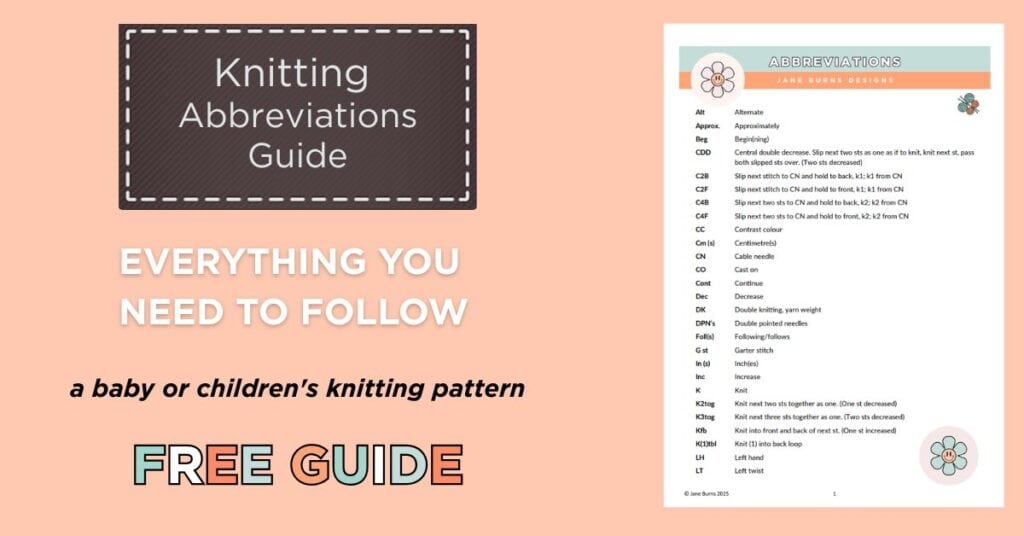
- Knitting Abbreviations Guide — the same treatment for knitting patterns
- Baby & Children’s Knitting Size Guide – Why Knitting for Babies Isn’t Just Making Smaller Adult Clothes
- Knitting for Babies and How to Get It Right — yarn choices, construction, and what to know before you cast on